Mitsubishi Dual Zone Mini Split: Complete 2-Zone Guide (2026)
Mitsubishi Mini Split Dual Zone:
(Complete 2-Zone System Guide)
What exactly is a dual-zone mini split? Is it actually better than buying two separate units? How do you calculate the BTUs for two different rooms sharing one compressor?
As an HVAC engineer, I see homeowners and amateur contractors mess up 2-zone systems constantly by using “simple math.” In this complete guide, we break down exactly how Mitsubishi dual-zone systems work, how much they cost, and the strict engineering rules you must follow to size them correctly.
What Is a Mitsubishi Dual-Zone Mini Split?
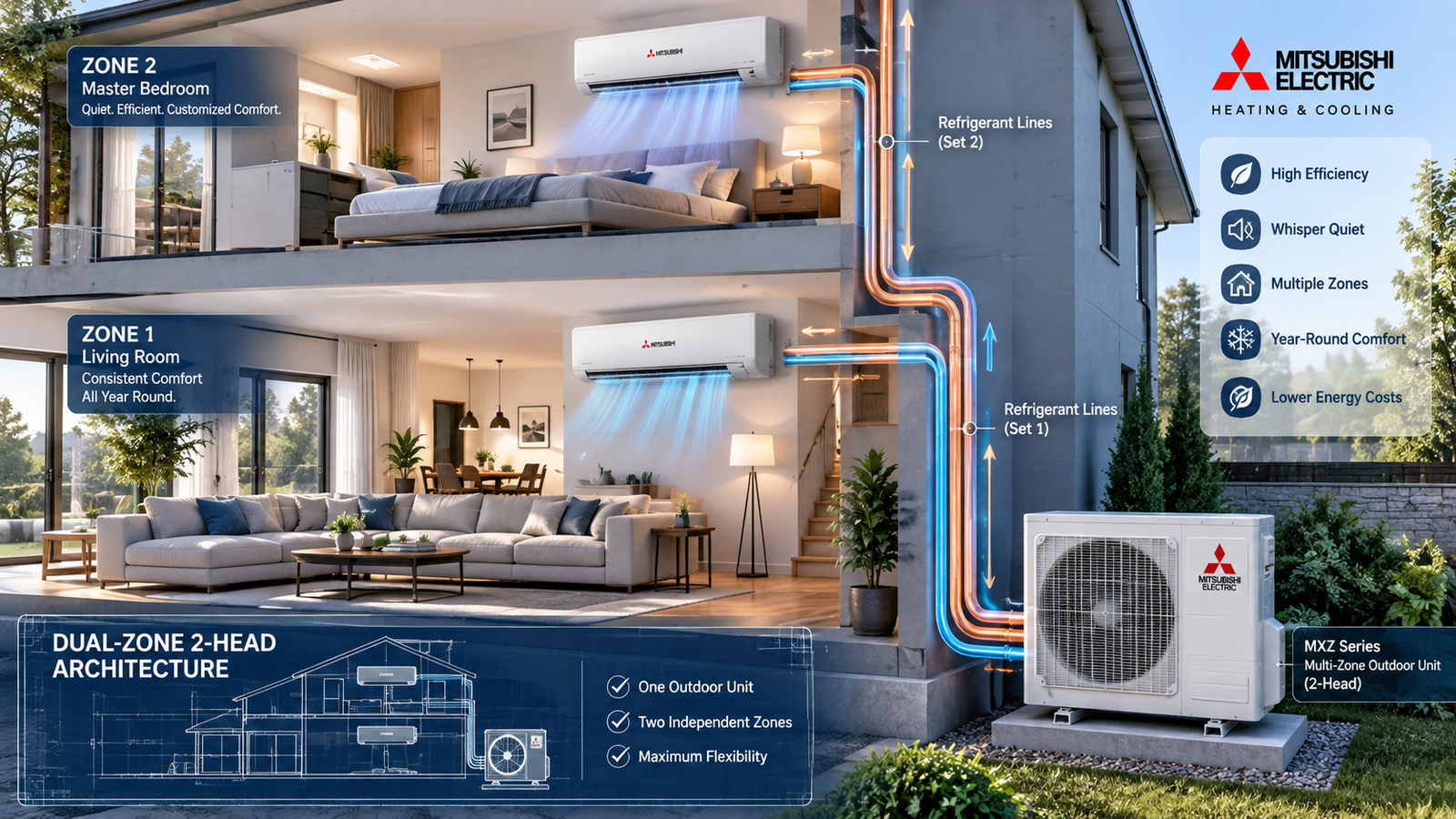
In a traditional ductless setup, one outdoor condenser connects to one indoor air handler. A Mitsubishi Dual-Zone system (often called a 2-head system) alters this architecture. It uses a specialized MXZ series outdoor condenser equipped with multiple refrigerant branch ports, allowing it to connect to exactly two indoor air handlers.
The Mini Split Hierarchy:
- Single-Zone: 1 Outdoor Unit → 1 Indoor Unit.
- Dual-Zone: 1 Outdoor Unit → 2 Indoor Units.
- Multi-Zone: 1 Outdoor Unit → 3 to 8 Indoor Units.
Read our broad architectural comparison: Single-Zone vs Multi-Zone Mini Split: Which is Best?
How Does a Mitsubishi Dual-Zone System Work?
You might be wondering: “If they share one outdoor unit, do both rooms have to be the exact same temperature?” No. Here is the engineering breakdown of how the system manages two spaces:
Independent Control
Each indoor unit has its own thermostat. Room A can be set to 68°F while Room B is set to 75°F. Electronic Expansion Valves (EEVs) inside the condenser direct the precise amount of refrigerant needed to each room based on individual demand.
Load Modulation
Mitsubishi’s INVERTER compressor acts like a gas pedal. If only one room needs cooling, the outdoor unit ramps down to partial capacity, saving electricity. It never blasts at 100% power if only 50% is required.
Mitsubishi Dual-Zone System Configurations
A 2-head Mitsubishi mini split is incredibly versatile. Here are the most common long-tail applications we design for homeowners:
| Configuration | Why It Works | Important Consideration |
|---|---|---|
| Two Bedrooms | Independent sleep comfort for two people. | Thermal loads are usually identical. |
| Living Room + Bedroom | Cools living area by day, bedroom by night. | Requires exact sizing for mismatched spaces. |
| Upstairs + Downstairs | Solves the “hot second floor” problem perfectly. | Heat distribution and line set routing. |
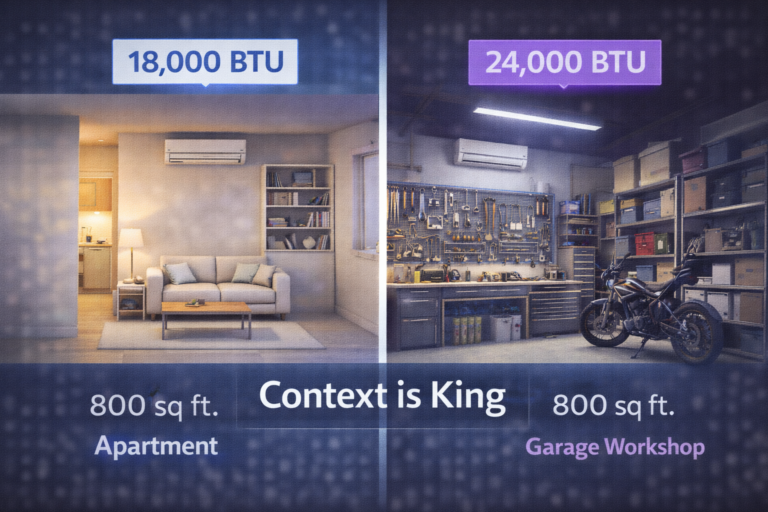
| Home + Garage | Cools a workspace using the home’s condenser. | Garages lack insulation; sizing is critical. |
| Two Rental Units | Gives two separate tenants their own thermostat. | Tenants must agree on Heat vs. Cool mode. |
How to Size a Mitsubishi Dual-Zone Mini Split
This is where 80% of DIYers and amateur contractors fail.
Do not fall into the trap of simple addition. You cannot just say, “I have a 9,000 BTU room and a 9,000 BTU room, so I must buy exactly an 18,000 BTU outdoor unit.” Mitsubishi systems must be designed based on approved AHRI match combinations and Load Diversity.
- 1. Individual Zone Load: First, calculate the exact thermal load of each room individually. (e.g., Zone 1 = 350 sq ft / Zone 2 = 500 sq ft).
- 2. Indoor Unit Selection: Select the indoor heads that match those loads.
- 3. Condenser Load Diversity: You must check Mitsubishi’s official compatibility charts. A 20,000 BTU outdoor condenser might comfortably run a 12k + 12k indoor combination. Why? Because the computer accounts for “load diversity”—the engineering assumption that both rooms will rarely demand 100% maximum power at the exact same microsecond.
Master the sizing process with our guides: Sizing Guide | The Truth About Manual J | What Size Do I Need?
Mitsubishi Dual-Zone Sizing Chart (Planning Guide)
While a strict Manual J calculation is mandatory for installation, use this chart as a high-level planning guide to understand common residential combinations:
| Zone 1 (Indoor) | Zone 2 (Indoor) | Typical Outdoor Unit | Typical Application |
|---|---|---|---|
| 9,000 BTU | 9,000 BTU | 18,000 or 20,000 BTU | Two small to medium bedrooms. |
| 9,000 BTU | 12,000 BTU | 20,000 BTU | Master bedroom + smaller guest room. |
| 12,000 BTU | 12,000 BTU | 24,000 BTU | Two large bedrooms or home offices. |
| 12,000 BTU | 18,000 BTU | 30,000 BTU | Large living area + master bedroom. |
⚠️ Note: We call this a “planning guide” because the final selection must be matched using official manufacturer combination data sheets to ensure EEV compatibility and avoid short-cycling.
Can One Mitsubishi Outdoor Unit Run Two Indoor Units?
Yes, as long as it is specifically engineered as an MXZ Multi-Zone condenser. It achieves this through:
- Refrigerant Lines: The outdoor unit has multiple dedicated flare connections for each indoor unit’s line set.
- Branch Connections: Intelligent valves route the Freon only to the room calling for air.
- Simultaneous Demand: The high-capacity inverter ramps up its RPMs to handle the total capacity of both rooms simultaneously if needed.
Mitsubishi Dual Zone vs Two Single-Zone Systems
If you need to cool two rooms, should you buy one Dual-Zone system, or two entirely separate Single-Zone systems? This is the ultimate design question.
| Design Factor | Dual Zone System | Two Single-Zone Systems |
|---|---|---|
| Outdoor Units | 1 | 2 |
| Installation Footprint | Lower (Saves space) | Higher (Clutters yard) |
| System Redundancy | Lower (If it fails, both rooms lose AC) | Higher (Independent backup) |
| Independent Operation | Yes (But must share same mode) | Total independence |
| Best Use Case | Limited outdoor space / HOA rules | Maximum reliability desired |
Deep dive into this topic: Single-Zone vs Multi-Zone: Which is Best?
Mitsubishi Dual Zone Cost
Why does a 2-zone system cost significantly more than a single-zone system? The answer lies in the hardware and labor.
- You are purchasing a heavier, more complex MXZ outdoor condenser.
- You are purchasing two distinct indoor air handlers instead of one.
- The contractor must buy and run double the amount of copper line sets and control wire.
- Installation labor doubles (multiple wall penetrations, complex drainage routing, and heavier electrical work).
For an exact dollar breakdown of equipment vs labor, check our detailed Mitsubishi Mini Split Cost Guide.
Best Mitsubishi Indoor Unit Types for Dual-Zone Systems
You are not restricted to just standard wall-mounted boxes. Mitsubishi allows you to mix and match indoor units on a dual-zone condenser:
Wall-Mounted (MSZ)
The most cost-effective and common option. Easy to install and perfect for standard bedrooms.
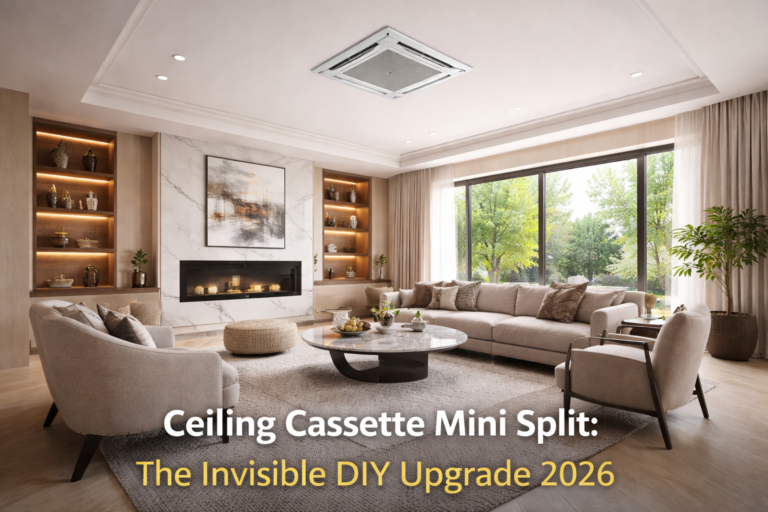
Ceiling Cassette (MLZ)
Sits flush between the ceiling joists, making it virtually invisible. Perfect for luxury living rooms.
Read the Ceiling Cassette Guide →
Case Study: Designing an Engineering-Grade 2-Zone System
The Property: A 1,000 sq ft home in a warm climate with two distinct areas needing AC: a large open living room and one master bedroom.
The Existing Problem: The homeowner wanted independent temperature control for sleeping, but their HOA strictly limited them to a single outdoor HVAC pad.
The Design Process:
- Step 1: Calculate each zone’s approximate load. (Living Room = ~15,000 BTU / Bedroom = ~9,000 BTU).
- Step 2: Select indoor capacities (18k wall unit + 9k wall unit).
- Step 3: Check compatible outdoor combinations. A 24,000 BTU MXZ condenser was selected because the system rarely demands 100% capacity in both rooms simultaneously.
- Step 4: Verify total line-set requirements to ensure they don’t exceed the compressor’s maximum pumping distance.
We didn’t guess based on square footage; we engineered the load. Calculate yours here.
Mitsubishi Dual Zone for Rental Properties
Dual-zones are popular in duplexes to save outdoor space, but they carry a failure risk: if Tenant A sets the system to Heat in October, and Tenant B tries to turn on the AC, the system will lock out. For completely separate tenants, we strongly advise two single-zone systems to ensure independent control.
Read: Best Mini Split for Rental Properties.
Mitsubishi Dual Zone in Cold Climates
Can one condenser heat two rooms during severe freezing weather? Yes, provided you upgrade to the Mitsubishi Hyper-Heating (H2i) multi-zone condenser. Standard condensers will fail below 32°F, but the H2i guarantees 100% capacity down to 5°F.
Read: Sizing for Cold Climates.
Common Mitsubishi Dual-Zone Installation Mistakes
- Incorrect Combinations: Pairing two indoor heads that the outdoor unit’s computer doesn’t support.
- Poor Line Routing: Exceeding the maximum vertical lift between the condenser and the indoor heads.
- Improper Drainage: Failing to account for gravity drops across two different rooms.
See the full list of errors in Top Mini Split Installation Mistakes.
Mitsubishi Dual Zone vs 3-Zone
If you are debating adding a third head “just in case,” be warned: jumping from a 2-zone to a 3-zone system requires a significantly larger compressor, higher voltage electrical work, and massive increases in copper line-set costs. Only upgrade if you actively need to condition a third room.
Read our 3-Zone System Guide.
Is a Mitsubishi Dual-Zone Mini Split Worth It?
Choose Dual Zone if:
- You need to cool exactly two independent rooms.
- Outdoor space is highly limited or restricted by an HOA.
- You want the efficiency of one large, modulated inverter compressor.
Consider Two Singles if:
- Redundancy is critical (if one fails, you have backup).
- The rooms have vastly different thermal loads.
- Complete independent operation (heating vs cooling) is required.
Frequently Asked Questions
How does a Mitsubishi dual-zone mini split work?
It uses a single outdoor inverter compressor connected via two separate sets of copper refrigerant lines to two independent indoor air handlers. The system routes the exact amount of refrigerant needed to each room based on individual thermostat demands.
How much does a Mitsubishi dual-zone system cost?
Fully installed by a licensed professional, a 2-zone Mitsubishi system typically ranges from $5,000 to $8,500. The cost depends on the capacity of the outdoor unit, the types of indoor heads chosen, and the complexity of running the line sets.
What size Mitsubishi mini split do I need for two rooms?
You must calculate the BTU load for each room independently. For example, two standard bedrooms usually require two 9,000 BTU indoor units paired with a single 18,000 or 20,000 BTU outdoor condenser.
Can two indoor units run at the same time?
Yes, absolutely. They can both run simultaneously, or one can run while the other is turned off. The only restriction is that they must both be in the same mode (both heating or both cooling).
Is dual zone better than two single-zone mini splits?
A dual-zone system is better if you want to save outdoor space and reduce the exterior footprint. However, two single-zone systems offer better redundancy (if one fails, the other still works) and are often easier to install.
Can a Mitsubishi dual-zone system heat both rooms?
Yes. All modern Mitsubishi dual-zone systems are heat pumps. If you purchase the Hyper-Heat (H2i) series, it can effectively heat both rooms even when outdoor temperatures plunge to -13°F.
Can I mix different indoor unit sizes?
Yes. It is very common to pair a larger unit (like 18,000 BTU) for a living room with a smaller unit (like 9,000 BTU) for a bedroom, as long as the total combination is approved by Mitsubishi’s engineering matrix.
How many BTUs does a dual-zone Mitsubishi need?
The total BTUs needed depends entirely on the combined square footage, insulation, and climate. Dual-zone outdoor units typically range from 18,000 BTUs up to 36,000 BTUs to handle the combined load of two rooms.