Mitsubishi Mini Split Defrost Cycle: How It Works & Fixes (2026)
Mitsubishi Mini Split Defrost Cycle Explained:
How It Works, How Long It Lasts & When It’s a Problem
“My Mitsubishi mini split is heating, but then it suddenly stops blowing warm air and the outdoor unit sounds different. Is it broken?” If you are asking this during a cold winter day, you are likely witnessing a perfectly normal thermodynamic process: the defrost cycle.
Quick Answer: What is a Mitsubishi mini split defrost cycle?
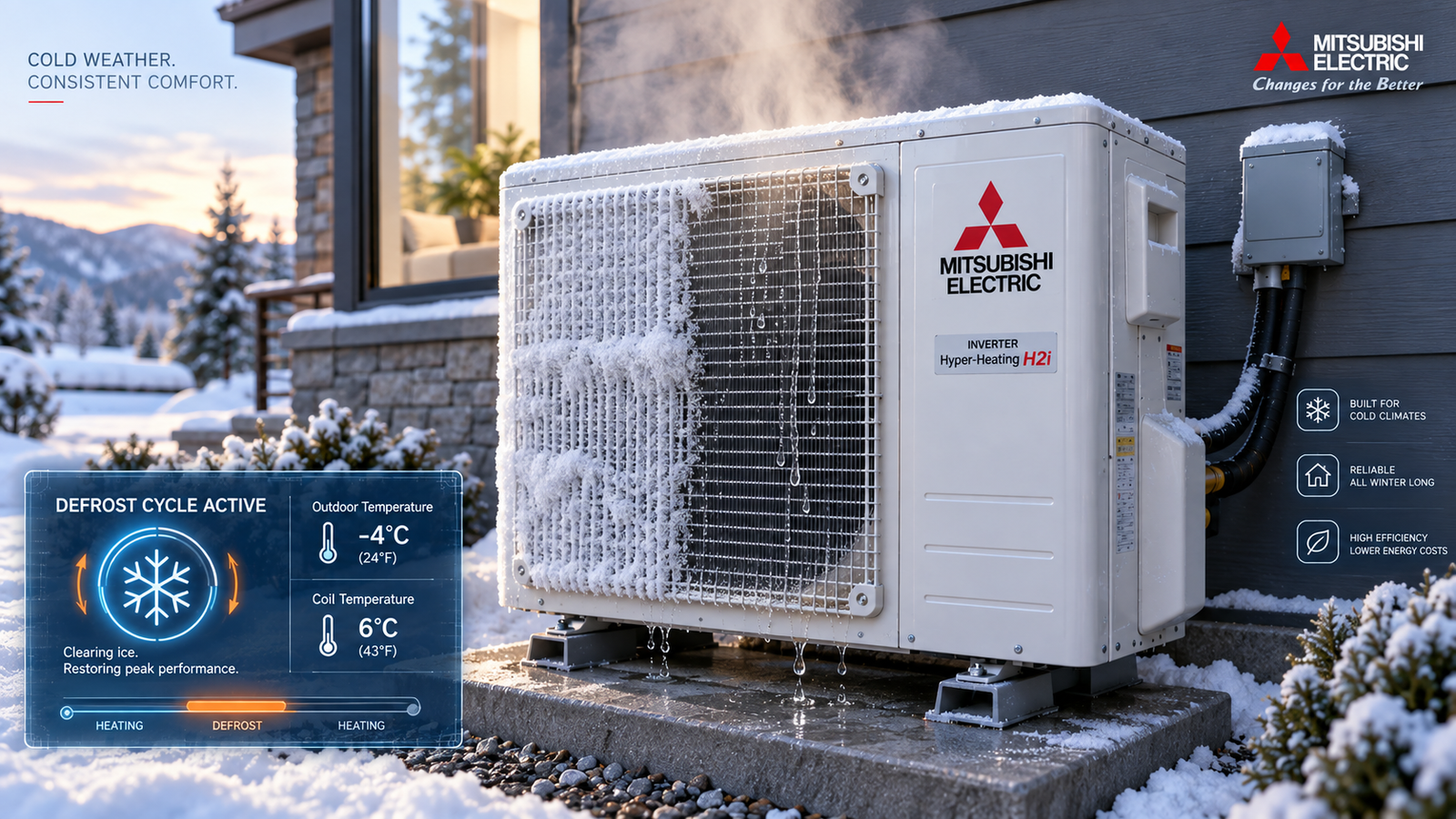
A Mitsubishi mini split defrost cycle is a temporary heat-pump operation that removes frost from the outdoor heat exchanger during heating. The system temporarily changes its operating cycle to transfer heat to the outdoor coil, allowing accumulated ice to melt before normal heating resumes. The important question is not whether defrost happens, but whether the system completes it normally and returns to heating.
In this technical guide, we explain why frost forms, what happens during defrost, how to recognize normal operation, and when persistent defrost behavior may indicate a problem.
What Is the Mitsubishi Mini Split Defrost Cycle?
To understand defrost, you must first understand frost. When your Mitsubishi heat pump is heating your home, the outdoor unit is acting as an evaporator. It is pulling latent heat out of the cold winter air.
If the outdoor temperature is low and the humidity is high, the surface temperature of the outdoor coil drops below the ambient dew point, and eventually below freezing. Moisture in the air physically condenses and freezes onto the aluminum fins. Because frost acts as an insulator, it severely reduces airflow and heat-transfer performance. A defrost strategy is mathematically necessary to clear this ice and restore efficiency. Seeing frost does not automatically mean the system is broken.
The Defrost Lifecycle
Why Does a Mitsubishi Mini Split Need Defrost?
Thermodynamically, a heat pump doesn’t “create” heat; it moves it. During the winter, the outdoor coil must be colder than the outside air to absorb heat energy.
- Coil Temperatures: If it is 35°F outside, the refrigerant inside the outdoor coil might be 20°F.
- Moisture Freezing: Ambient moisture touches this sub-freezing coil and instantly forms frost.
- Airflow Blockage: If left unchecked, this frost bridges the microscopic gaps between the aluminum fins, blocking the outdoor fan from pulling air through the unit. Without airflow, the system cannot absorb heat.
What Happens During a Mitsubishi Defrost Cycle?
Mitsubishi heat-pump systems use model-specific controls and temperature sensing to manage defrost. The sequence below describes the general reversing-cycle principle; exact control behavior varies by model:
1. Defrost Initiation
The control system determines when defrost is required using model-specific temperature sensing and control logic.
2. Refrigerant-Cycle Reversal
In a reversing-cycle heat pump, the four-way valve changes refrigerant flow so heat is delivered to the outdoor heat exchanger, where it can melt accumulated frost. Exact valve and refrigerant-flow behavior is model-specific.
3. Frost Melts
Outdoor fan operation may change or stop during defrost, depending on the model and control sequence. As the outdoor heat exchanger warms, accumulated frost can melt and produce water; visible vapor may also occur in some weather conditions.
4. Recovery
When the system determines that defrost is complete, it exits the defrost sequence and resumes normal heating. The exact termination criteria and sensor logic vary by model.
How Can You Tell If Your Mitsubishi Is in Defrost Mode?
Because a Mitsubishi system temporarily halts indoor heating to clear the outdoor coil, homeowners often panic. Here is a practical checklist of normal defrost indications:
Indoor Observations
- The indoor fan may stop or change speed to limit uncomfortable cool airflow, depending on the model.
- Airflow direction or louver behavior may change during the cycle on some models.
- You may hear a change in refrigerant or valve-related operating sounds as the system changes state.
- Indicator-light behavior varies by model and should not be used alone to confirm defrost.
Outdoor Observations
- The outdoor fan may stop or change operation during defrost, depending on the model.
- Compressor or refrigerant operating sounds may change during the cycle.
- Visible frost rapidly disappears from the rear fins.
- Water drains heavily from the bottom of the chassis.
- Steam or water vapor may rise from the unit.
Important: Do not assume every Mitsubishi model displays a universal “DEFROST” text on the remote. Indicators vary wildly depending on whether you use a standard remote, a wired wall controller, or the Kumo Cloud app.
Does a Mitsubishi Mini Split Blow Cold Air During Defrost?
Yes. During defrost, occupants may notice a temporary reduction in heating output or a cooler-feeling airflow, depending on the system and its controls.
During a reversing-cycle defrost, heat is temporarily directed to the outdoor heat exchanger. Indoor airflow may be reduced or stopped to limit the delivery of cool air, although the exact indoor-unit behavior depends on the model and controls.
Read our diagnostic guide: Mitsubishi mini split not heating.
How Long Does a Mitsubishi Mini Split Defrost Cycle Last?
Important: There is no single defrost duration that applies to every Mitsubishi mini split.
A defrost cycle ends when the system’s model-specific control logic determines that the outdoor heat exchanger has been sufficiently cleared. The time can vary with the equipment design and operating conditions, including outdoor temperature, moisture availability, and frost accumulation.
How Often Should a Mitsubishi Mini Split Go Into Defrost?
Frequency is influenced heavily by operating conditions. Defrost frequency depends on frost formation and operating conditions. Colder weather does not by itself determine frequency; moisture availability, coil conditions, system design, and control logic all matter.
Frequent defrost does not automatically mean failure. However, unusually frequent or incomplete defrost, persistent ice buildup, or failure to return to normal heating can justify a professional inspection.
Mitsubishi Mini Split Defrost vs. a Heating Problem
How do you know if you should wait it out or call a professional? Use this comparison chart. (Note: These symptoms point toward conditions, but never use a symptom alone as a definitive diagnosis.)
| Symptom Observation | Consistent with Normal Defrost | Consistent with a Fault |
|---|---|---|
| Temporary change in heating output | ||
| Frost physically disappears during the cycle | ||
| Heating returns after the defrost event completes | ||
| System remains unable to heat for hours | ||
| Solid, thick ice continues building relentlessly | ||
| Error code appears on remote or unit LEDs |
Mitsubishi Mini Split Stuck in Defrost: Possible Causes
If the outdoor unit remains heavily iced, defrost does not clear the frost, or the system repeatedly enters defrost without recovering normal heating, a mechanical, installation, maintenance, or environmental issue may be involved. Possible categories include:
Restricted Outdoor Airflow
Snow drifts, overgrown bushes, or fences placed too close prevent proper ventilation.
Dirty Outdoor Heat Exchanger
Packed dirt or pet hair acts as an insulator, destroying coil performance.
Sensor / Thermistor Issue
If the coil temperature sensor fails, the board won’t know when to initiate or terminate defrost.
Refrigerant-System Issue
Refrigerant-system problems can affect heat transfer and may contribute to abnormal frost or defrost behavior; diagnosis requires appropriate HVAC instruments and procedures.
Four-Way Valve Issue
A physically stuck reversing valve prevents the system from switching cycles.
Outdoor Fan Problem
A failed or malfunctioning outdoor fan can severely reduce airflow and may contribute to rapid frost accumulation and poor heating performance.
What Should I Check Before Calling an HVAC Technician?
Before paying a dispatch fee, perform this safe, homeowner-level diagnostic checklist:
Safe to Check
- Confirm the remote is explicitly set to HEAT (Sun icon), not AUTO.
- Check and clean your indoor air filters.
- Verify outdoor airflow is completely unobstructed.
- Look for excessive snow or ice accumulation around the base.
- Note any flashing lights on the indoor unit.
DO NOT Attempt
- Do not attempt to add or check refrigerant pressures.
- Do not open the outdoor electrical casing.
- Do not pour boiling water over a frozen outdoor unit.
- Do not attempt to bypass sensors or force a defrost via service switches.
Noticed blinking lights? Decode them safely via our Mitsubishi Error Codes List.
Does Defrost Use More Electricity?
Defrost has an energy cost because the system temporarily operates to remove frost rather than provide normal indoor heating. Frost itself also reduces heat-transfer performance, so a functioning defrost strategy is an important part of heat-pump operation.
Does Cold Weather Cause More Defrost Cycles?
Not necessarily. Defrost demand depends on frost formation, which is influenced by outdoor temperature, moisture availability, system design, and control logic. Temperature and humidity should be considered together rather than assuming that colder weather always produces more defrost.
Mitsubishi Hyper-Heating and Defrost Performance
Not all Mitsubishi units handle frost the same way. Mitsubishi’s Hyper-Heating (H2i) products use advanced flash-injection compressor technology designed specifically to maintain heating performance in low outdoor temperatures.
Mitsubishi states that the PUZ-HA Hyper-Heating system uses Flash Injection to improve start-up and recovery from defrosting, and that its defrost-operation control improves the required defrost frequency. These claims apply to the specified product family and should not be generalized to every Mitsubishi model.
Illustrative Engineering Scenario: Defrost in Cold, Humid Conditions
Assumption: Consider an 18,000 BTU-class Mitsubishi heat pump operating in heating mode during cold, humid weather. This is an illustrative scenario, not a documented installation or field test.
- Observation: Visible white frost begins bridging the aluminum fins on the outdoor coil. Heat transfer drops.
- Action: The thermistor detects the temperature differential and initiates defrost. The indoor fan pauses to prevent cold drafts. The reversing valve shifts.
- Result: Steam rises from the outdoor unit as the hot refrigerant melts the frost. Water pours out the drain holes.
- Interpretation: If frost clears and normal heating resumes, the behavior is consistent with a normal defrost cycle. This illustrative scenario does not establish a universal cycle duration.
Read more on specific capacities: Mitsubishi 18,000 BTU Review.
How to Reduce Unnecessary Frost and Defrost Problems
While you cannot eliminate normal defrost, you can actively reduce abnormal frost problems that lock up your system:
- Maintain Clear Airflow: Keep the coil unobstructed. Remove bushes, debris, and snowdrifts. (Review clearance requirements).
- Keep Drainage Clear: Ensure the outdoor unit is elevated above the snow line so defrost water can drain away rather than refreezing at the base.
- Maintain Filters: Clean indoor filters ensure proper heat exchange, which prevents the system from running erratically. (See cleaning guide).
When Should You Call an HVAC Professional?
Make the safety boundary very clear. Call a qualified, licensed technician when:
- The system remains in apparent defrost unusually long or cycles repeatedly without heating.
- Ice keeps accumulating into a solid, thick block that never clears.
- Specific error codes appear on the indoor unit or outdoor logic board.
- The outdoor unit makes abnormal screeching or grinding sounds.
- You suspect refrigerant-system faults or electrical failures.
Mitsubishi Defrost Troubleshooting Flowchart
Sources & Manufacturer Documentation
Technical details in this guide should be interpreted in the context of the specific Mitsubishi model. Manufacturer documentation is the primary reference for model-specific control behavior, service procedures, and operating limits.
Mitsubishi Mini Split Defrost FAQ
How long does a Mitsubishi mini split defrost cycle last?
Why does my Mitsubishi mini split blow cold air when heating?
How often should a Mitsubishi mini split defrost?
Is frost on a Mitsubishi mini split normal?
Can I manually force my Mitsubishi into defrost?
What is the difference between defrost and a Mitsubishi heating fault?
Summary
Normal defrost is a necessary part of heat-pump operation in cold climates. The key is whether the Mitsubishi system successfully completes the defrost cycle and naturally returns to normal heating. Persistent ice, repeated abnormal behavior, flashing error codes, or failure to recover heat should move you from observation to scheduling a professional HVAC diagnosis.