What Size Mini Split for a Bedroom? The Sleep Comfort Guide (2026)
There is nothing worse than trying to sleep in a hot, stuffy room. Or perhaps worse: trying to sleep with a noisy, rattling window AC unit next to your head.
Installing a mini split in your bedroom is the ultimate upgrade for sleep quality. It’s whisper-quiet and efficient. But when it comes to sizing a bedroom unit, most people make a critical mistake.
They think “I want it freezing, so I’ll buy a big unit.” Do not do this.
In a bedroom, an oversized unit will cool the room in 5 minutes and shut off. The result? The humidity stays high, leaving you feeling cold, clammy, and uncomfortable under the covers.
In this guide, I will show you the perfect size for sleep comfort and why “Decibels” matter just as much as BTUs.
💤 Sleep Soundly: Not sure if you need 6k, 9k, or 12k? Use our [Free Mini Split Calculator] to get the exact number for your room dimensions.
The “Goldilocks” Rule for Bedrooms
For a bedroom, you want a unit that runs at a low, consistent speed rather than blasting on and off. This keeps the air dry and crisp.
Standard Bedroom Sizing Rule:
For most bedrooms, 9,000 BTU is King.
Unless you have a massive master suite with cathedral ceilings, a 9k unit is almost always the perfect choice. In fact, for small guest rooms, even 9k might be too much (which is why 6k units exist).
👉 This Mini Split Guide (2026) shows what’s often overlooked
Bedroom BTU Chart (2026)
| Bedroom Size | Ceiling Height | Recommended Size |
| Small Room (100 – 150 sq. ft.) | 8 ft | 6,000 BTU (or 9k Inverter) |
| Standard Master (150 – 300 sq. ft.) | 8 ft | 9,000 BTU (0.75 Ton) |
| Large Master Suite (300 – 500 sq. ft.) | 8-10 ft | 12,000 BTU (1 Ton) |
| Attic Bedroom (Poor Insulation) | Sloped | 12,000 BTU |
Beyond BTUs: The “Noise Factor” 🤫
In a garage, you don’t care about noise. In a bedroom, Decibels (dB) are everything.
A standard window AC creates about 50-60 dB of noise (like a loud conversation). A quality Mini Split creates 19-25 dB (whisper quiet).
When buying for a bedroom, check the spec sheet:
- Excellent: 19 dB – 22 dB (You won’t hear it running).
- Good: 23 dB – 28 dB (White noise).
- Avoid: Anything over 35 dB for the indoor unit.
The “Ghost Light” Problem 👻
Here is a tip nobody tells you until it’s too late: LED Displays. Some cheaper mini splits have a bright LED temperature display on the front panel that glows like a neon sign in the dark.
- Pro Tip: Look for units with a “Sleep Mode” or “LED Off” feature on the remote. Brands like MrCool and Mitsubishi allow you to turn off the display light so your room stays pitch black.
Placement: Where to Mount It?
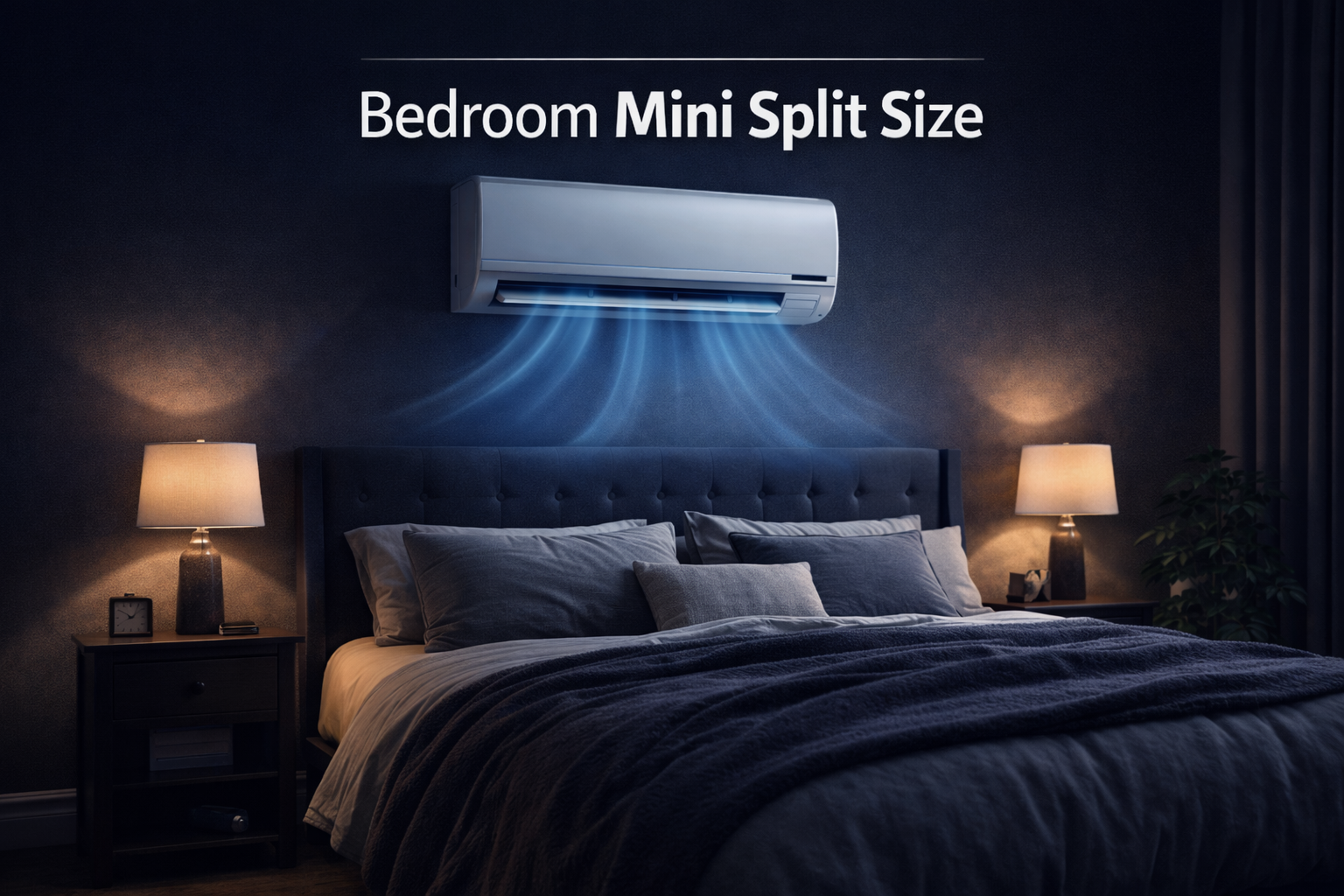
Never mount the unit directly above the head of your bed.
- Safety: It’s rare, but condensation leaks happen. You don’t want water dripping on your face at 3 AM.
- Airflow: You don’t want cold air blowing directly on your nose (it dries out your sinuses).
Best Spot: On the wall perpendicular to the bed, or above the window, aiming the air toward the foot of the bed.
Conclusion: Smaller is often Better
For bedrooms, resist the urge to go big. A properly sized 9,000 BTU unit will run quietly in the background, removing humidity and keeping you in deep sleep all night.
Don’t guess on the size.
👉 [Check your room size with our Calculator] It takes 10 seconds and ensures you don’t buy a unit that leaves you feeling clammy.