Mini Split Sizing for Cold Climates (2026): Sub-Zero Heating Guide
Mini Split Sizing for Cold Climates
Standard sizing charts freeze at 32°F. If you live in Maine, Canada, or the Midwest, you need the “Arctic Protocol.” Learn why a 12k unit becomes a 6k unit in the dead of winter.
The “Nominal” Trap
In HVAC engineering, we distinguish between Nominal Capacity (measured at 47°F) and Actual Capacity (measured at winter lows). If you size your home based on the number on the box, you will be shivering in January. A Mitsubishi 18k Hyper-Heat is NOT the same as a cheap 18k unit when the mercury drops.
Run a Cold-Climate Load CalculationThe Physics: Heating vs. Cooling Sizing
Most sizing tools focus on cooling. But in cold climates, Heating Load is almost always higher than cooling load.
The Cooling War
You are fighting a 20-30°F difference (95°F outside vs 72°F inside).
The Winter War
You are fighting a 70-80°F difference (0°F outside vs 70°F inside).
Conclusion: Can a mini split heat a whole house? Yes, but only if you size for the Winter Delta T, not the Summer Delta T.
Capacity Derating: Standard vs. Hyper-Heat
| Outdoor Temp | Standard 12k Unit | Hyper-Heat 12k Unit | Verdict |
|---|---|---|---|
| 47°F (Ideal) | 12,000 BTU | 13,200 BTU | Maximum Efficiency |
| 17°F (Freezing) | 7,800 BTU | 12,000 BTU | Standard units fail here |
| 5°F (Sub-Zero) | 5,200 BTU | 12,000 BTU | Hyper-Heat is required |
*Comparison based on Mitsubishi H2i vs Generic SEER 14 systems.
The “Defrost” Factor in Sizing
In sub-freezing weather, your outdoor unit turns into a block of ice. The system must reverse itself to melt that ice. This is the Defrost Cycle.
During Defrost:
- The indoor unit stops heating.
- Energy is spent melting outdoor coils.
Engineer’s Pro Tip 🧠
Because a system can spend 10-15 minutes every hour in defrost mode, you must Oversize the unit by 10-15% in high-humidity cold climates (like the Northeast US) to compensate for “Heating Downtime.”
Read the Manual J Deep Dive →Case Study: The Vermont Winter Challenge
The 900 Sq Ft “Ice Box”
The Space: 900 sq ft cabin, Vermont. Average winter temp: 10°F.
The Error: Contractor installed a 24k BTU standard efficiency unit.
The Fail: At 10°F, the unit’s output dropped to 13k BTUs. The cabin stayed at a freezing 58°F.
The Engineering Solution
We swapped the unit for a 24k Mitsubishi Hyper-Heat (FS Series). Because Hyper-Heat maintains 100% capacity at 5°F, the cabin stayed at a steady 70°F even during a blizzard.
3 Must-Haves for Cold Climate Mini Splits
Base Pan Heater
Prevents ice buildup in the bottom of the outdoor unit, which can shatter fan blades.
Wall Brackets
Mount the unit 2 feet above the ground to avoid burial by snow. Bracket vs Stand Guide.
Backup Heat
Always have a “Stage 2” heat source (like baseboard or wood) if temps drop below -20°F. Heat Pump vs Furnace.
FAQ: Freezing Weather Sizing
Do mini splits work in -20 degree weather?
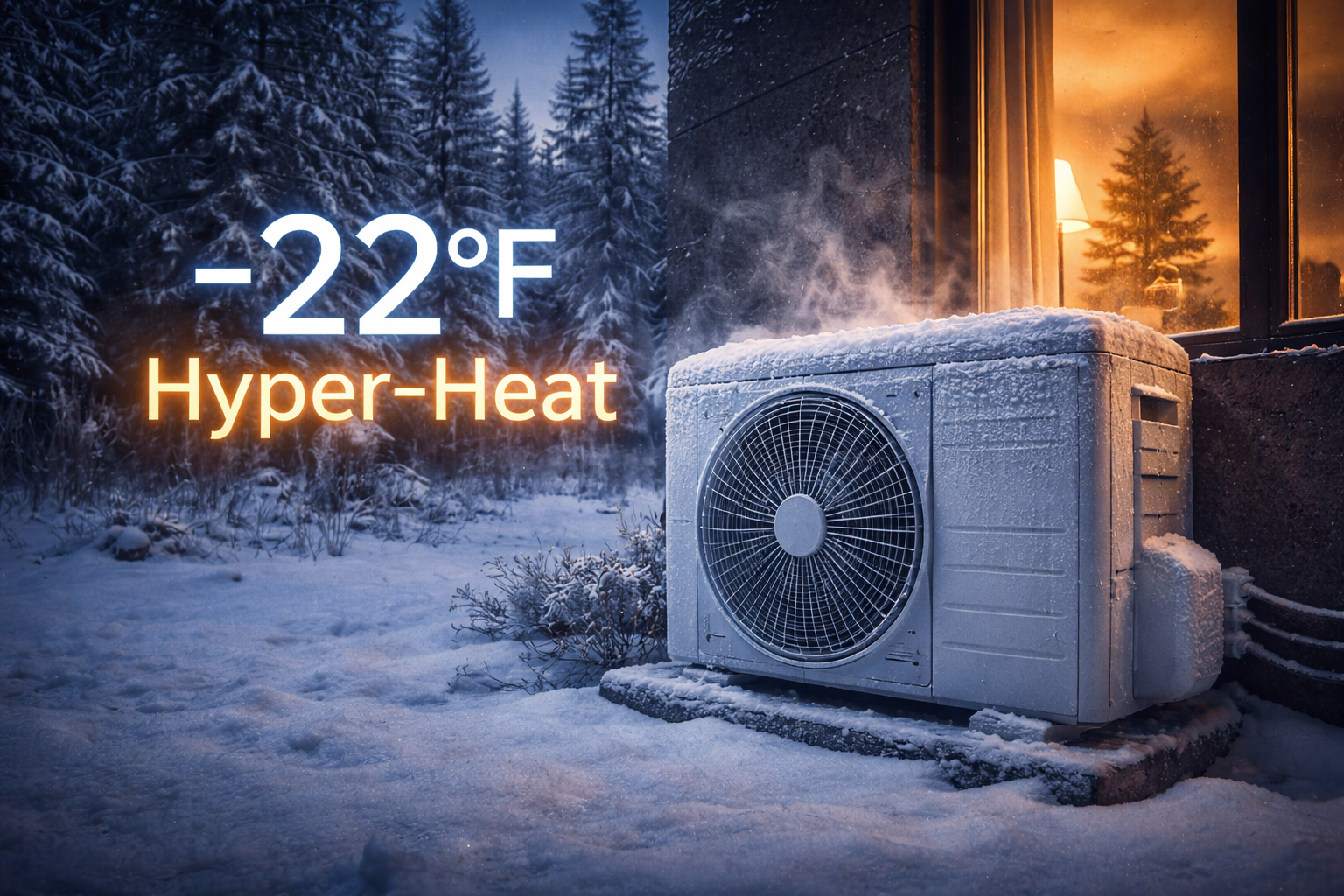
Only specific “Cold Climate” models (like Mitsubishi Hyper-Heat, Fujitsu XLTH, or LG Red) are rated to operate at -13°F or -22°F. Standard units usually cut off around 5°F to protect the compressor.
Should I oversize my mini split for heating?
Yes, slightly. Because heating capacity drops with temperature, you should size the unit based on its output at the Design Temperature of your city (e.g., 5°F), not its nominal 47°F rating.
What is HSPF2 and why does it matter?
HSPF2 measures heating efficiency over a season. For cold climates, look for an HSPF2 of 9.5 or higher. This ensures lower electric bills in winter. See Most Efficient Systems.
Don’t Get Left in the Cold.
Cold climate sizing is an engineering discipline. Use our specific heat-loss calculator to find your design temperature load.