Mini Split Cost Calculator:
See Your Price & Monthly Electric Bill Instantly
Stop guessing. Our interactive 2026 calculator gives you a real estimate for equipment, installation labor, and running electricity costs — tailored to your BTU size, brand, and local utility rate.
What’s In This Guide
“How much does a mini split cost?” — Most sites give a useless range like $1,000–$10,000.
As HVAC engineers, we built this 2026 calculator to give you precise, personalized estimates based on your BTU size, brand tier, install complexity, and local electricity rate. This is the number your contractor will actually quote.
Before you invite a single contractor into your home, you need a baseline. Below we break down what drives costs up or down, followed by our interactive calculator so you can plan your full budget — upfront and monthly.
The Two Halves of Your Invoice: Equipment vs. Labor
When a contractor hands you a quote, it typically splits roughly 40% equipment / 60% labor. Understanding why helps you negotiate smarter and spot inflated bids.
The Equipment (≈40%)
A budget 12,000 BTU unit (like Pioneer) runs ~$800 wholesale. The same-size Mitsubishi with Hyper-Heating inverter technology and a 12-year warranty? ~$1,900 wholesale. Brand tier is the #1 equipment cost driver.
See Mitsubishi Cost BreakdownThe Labor (≈60%)
Running copper line sets, pulling a 500-micron deep vacuum, wiring a 220V circuit, and pulling permits — this requires licensed expertise. Labor cost doubles for second-floor installs or panel upgrades.
Full Installation Cost GuideCalculating Your Annual Electricity Cost
The biggest mistake homeowners make: buying a cheap, low-efficiency unit — then watching utility bills climb. Three factors determine your real running cost:
Local kWh Rate
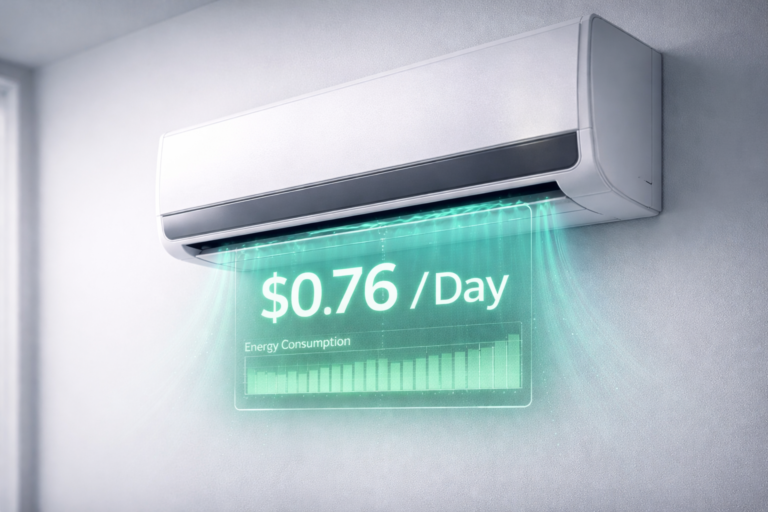
US avg in 2026 is ~$0.16/kWh. California & New York often exceed $0.30/kWh — doubling your monthly bill.
SEER2 Rating
Premium brands operate at 20+ SEER2. Higher SEER = fewer watts to produce the same cooling or heating.
Daily Usage Hours
An inverter unit running 24/7 at low speed often costs less than a standard unit cycling on and off every hour.
2026 Mini Split Cost Calculator
Adjust the options below to instantly estimate your total investment and monthly running costs.
Your Estimated Costs
*Annual cost based on 7 active months. Tax credit estimate assumes 30% IRA credit up to $2,000 on qualifying heat pump systems. All figures are 2026 national averages.
Understanding the Calculator’s Math
The electricity cost formula we use is based on real engineering, not guesswork:
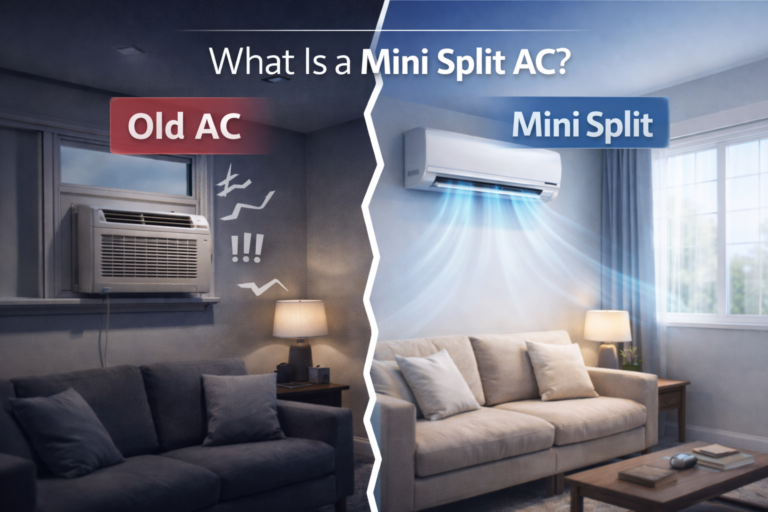
The 0.6 load factor is critical: inverter mini splits throttle their compressor down once a room reaches target temperature. They rarely run at 100% capacity, which is why they’re so much cheaper to operate than old-school window units that blast full-power or nothing.
2026 Mini Split Brand Comparison
Which brand gives the best value for a 12,000 BTU single-zone system? Here’s how the top brands stack up on price, efficiency, and warranty.
| Brand | Tier | Equip. Cost (12K BTU) | SEER2 | Warranty | Best For |
|---|---|---|---|---|---|
| Pioneer / Senville | Budget | $750–$1,050 | 16–18 | 5 yr parts | Garage, rental unit |
| MRCOOL (DIY) | Budget/DIY | $1,100–$1,400 | 20–22 | 7 yr compressor | Confident DIYers |
| LG / Fujitsu | Mid-Range | $1,300–$1,700 | 20–22 | 7–10 yr | Most homeowners |
| Daikin | Premium | $1,600–$2,100 | 22–25 | 12 yr parts | Long-term investment |
| Mitsubishi Electric | Premium | $1,800–$2,400 | 23–33 | 12 yr (registered) | Cold climates, primary heat |
2026 Tax Credits & Rebates You Can Stack
One of the most overlooked money-savers: the federal Inflation Reduction Act (IRA) Section 25C credit still applies to qualifying mini split heat pumps in 2026. Here’s how to maximize savings:
Federal Section 25C Tax Credit
30% of project cost, up to $2,000 for qualifying heat pump systems. Requires ENERGY STAR certification and licensed installation.
Saves up to $2,000State & Utility Rebates
Many utilities add $200–$1,500 on top of the federal credit. Some states (like MA and CO) offer additional $1,000–$3,000 cold-climate heat pump incentives.
Check DSIREUSA.org for your state →💡 Pro Tip: Rebates can stack with federal credits.
A $5,000 system could net out at under $2,500 after a $1,500 federal credit + $1,000 state rebate. Always confirm eligibility using the AHRI certificate for your exact model before purchasing.
2026 Cost by Number of Zones
Zones are the #1 cost driver. Each additional indoor unit adds equipment, copper line set, and 4–8 hours of labor. Here’s what to expect nationally in 2026:
| Configuration | Typical Sq Footage | Installed Cost Range | Best For |
|---|---|---|---|
| 1-Zone (Single) | 150–750 sq ft | $2,500–$6,000 | One room, garage, addition |
| 2-Zone | 600–1,200 sq ft | $5,000–$8,500 | Small homes, 2-bedroom condos |
| 3-Zone | 900–1,800 sq ft | $8,000–$12,500 | Mid-size homes, no existing ductwork |
| 4-Zone | 1,200–2,400 sq ft | $11,000–$15,000 | Whole-home comfort, older homes |
| 5-Zone | 1,500–3,000 sq ft | $14,000–$20,000+ | Large homes replacing central HVAC |
Frequently Asked Questions
How accurate is this calculator for all US states?
What is a good SEER2 rating for a mini split in 2026?
Are premium brands worth the higher upfront cost?
Can I install a mini split myself to save money?
What is the federal tax credit for mini splits in 2026?
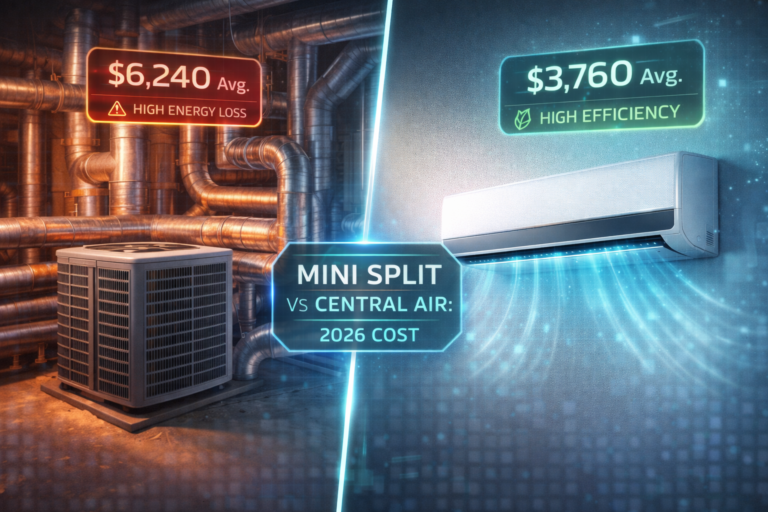
Is a mini split cheaper than central AC if I have no existing ductwork?
Ready for Real Quotes?
Use the calculator estimate above as your baseline. Then get at least 3 itemized quotes from licensed HVAC contractors. Ask each one for their SEER2 rating, exact model numbers, and what permits are included.
Last updated: March 2026 · MiniSplitSizer Engineering Team · All estimates based on 2026 US national market data.