Can a Mini Split Really Heat a Whole House in Freezing Weather? (2026 Truth)
For decades, there was a myth in the HVAC world: “Heat pumps are only for Florida. If you live in the North, you need a gas furnace.”
Ten years ago, that was true. In 2026, that is a lie.
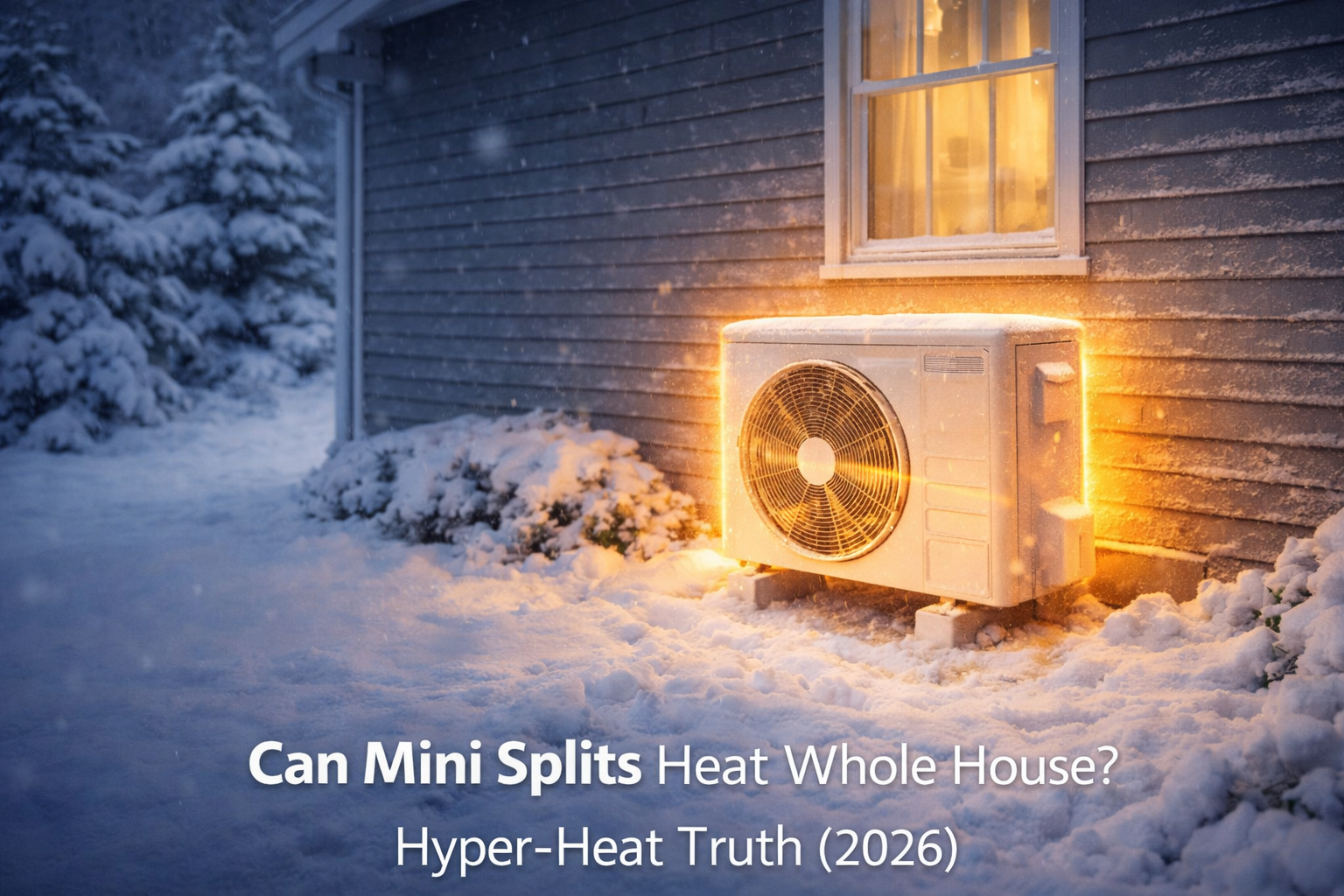
Modern Mini Splits (which are technically “Ductless Heat Pumps”) have evolved efficiently. Thanks to “Hyper-Heat” technology, these units can now pull heat out of thin air even when it is -22°F (-30°C) outside.
But can they replace your furnace entirely? Or will you wake up freezing in the middle of January? In this guide, I will explain the limits of ductless heating and how to size your unit for the winter worst-case scenario.
How Does It Create Heat from Ice? ❄️➡️🔥
It seems like magic, but it’s physics. Even at 0°F, there is still thermal energy in the air. A mini split doesn’t “create” heat (like burning gas or oil); it simply moves heat.
- The outdoor unit extracts hidden heat energy from the cold outside air.
- It compresses this energy to make it hot.
- It pumps it inside your room.
Because it moves heat instead of creating it, it is 300% to 400% more efficient than an electric space heater. For every $1 of electricity you pay, you get $3 or $4 worth of heat.
👉 Mini splits aren’t complicated once you understand the system Read this Guide (2026)
The “Hyper-Heat” Difference (Don’t Buy the Wrong Unit)
This is the most critical part for winter buyers. Standard mini splits work fine down to 15°F. Below that, they lose power and stop working.
If you live in a region with real winters (New York, Midwest, Canada), you MUST buy a unit labeled as:
- Hyper Heat (Mitsubishi/Pioneer)
- Olympus / Hyper (MrCool)
- Low Ambient Heating
These units are equipped with a special pan heater to prevent freezing and an enhanced compressor that maintains 100% capacity even at 5°F.
⚠️ Warning: If you buy a cheap, standard “Cooling Only” or “Standard Heat” unit for a Chicago winter, you will be cold. Check the spec sheet for “Operating Range.”
Sizing for Heat vs. Sizing for Cool 📏
Here is where sizing gets tricky. Sometimes, a room needs 9,000 BTUs to stay cool in summer, but needs 12,000 BTUs to stay warm in winter (because heat escapes faster than cold).
Which number do you pick? Always size for the dominant need.
- If you live in Arizona: Size for Cooling.
- If you live in Maine: Size for Heating (Go bigger).
Inverter units are smart. If you buy the 12k unit for heating, it will simply ramp down to 9k in the summer. It is safe to oversize slightly for heating purposes.
✅ Double Check: Use our Free Mini Split Calculator. If you live in a cold climate, select “Poor Insulation” to simulate the extra heating load required.
Can It Replace My Furnace? (The Backup Plan)
Yes, for 90% of homes. Many modern homes are switching to “Whole Home Ductless,” installing a multi-zone system and ripping out their old oil or propane furnaces.
However, I recommend a “Dual Fuel” approach: Keep your old baseboard heaters or furnace as an “Emergency Backup.” Why?
- If temperatures drop to historic lows (-30°F), the mini split might struggle.
- If the power goes out, you might have a generator that can run a small gas furnace but not a whole heat pump.
What About the “Defrost Cycle”? 💨
New owners often panic when their heater stops working for 5 minutes and makes a “whooshing” sound. This is normal. The outdoor unit is simply melting the ice off itself (Defrost Mode). It will blow cold air or stop blowing for a few minutes, then kick back into heat mode. Do not turn it off.
The Future is Electric
Gas is getting expensive. Oil is messy. Electric heat pumps are the future. With a Hyper-Heat mini split, you can stay toasty warm all winter for a fraction of the cost of electric baseboards.
Just make sure you get the right size to handle the coldest night of the year.