Fujitsu vs. Mitsubishi Mini Split: The Real Difference
Most comparison articles list the specs and call it a day. This one explains why the numbers are different, which differences actually matter to a homeowner, and which ones are just marketing noise.
Who Actually Makes These Units
Before comparing specs, understand the corporate structure — because it changes how you think about parts availability and long-term support.
Mitsubishi Electric is a division of Mitsubishi Electric Corporation, one of Japan’s largest industrial conglomerates. In the US, they partnered with Trane Technologies (Ingersoll Rand) for distribution. This means your local Trane dealer can often source Mitsubishi parts, and the service network is the deepest of any premium mini split brand in North America — roughly 3,000+ Diamond Contractor locations as of 2026.
Fujitsu General is a subsidiary of Fujitsu Ltd., primarily known in the US for its IT products. Their HVAC division is separate and wholly focused on ductless systems. In 2023-2024, Fujitsu rebranded their residential line from “Halcyon” to “Airstage H-Series” — the engineering is identical, only the product naming changed. Their Elite Contractor network in the US is smaller than Mitsubishi’s, which matters significantly for rural homeowners or anyone who needs warranty service.
The Real Engineering Difference: Compressor Technology
Every article on this topic lists temperatures and decibels. Very few explain why these units behave differently at those temperatures. This is the part that matters.
Mitsubishi H2i: Flash Injection Vapor Technology
Mitsubishi’s Hyper Heat H2i technology uses a process called flash injection at the compressor level. Here is what actually happens:
In a standard mini split operating at sub-zero temperatures, the amount of refrigerant circulating in the system decreases as the outdoor coil struggles to absorb heat from thinner, colder air. Less refrigerant circulating = less heat transferred = capacity falls off a cliff. A standard mini split loses 40-60% of its rated heating capacity at 0°F.
Mitsubishi’s flash injection bypasses a portion of the refrigerant directly to the compressor through an injection port, essentially “supercharging” the compressor with additional vapor. This increases the mass flow rate of refrigerant even when outdoor temperatures drop, maintaining capacity at temperatures where standard systems would fail. The result: 100% rated capacity maintained down to 23°F, and 76% capacity at -13°F.
Fujitsu XLTH: Engineered Cold-Weather Package
Fujitsu took a different but equally effective engineering approach. Their XLTH (Extra Low Temperature Heating) platform addresses cold-weather operation through three simultaneous mechanisms:
1. Enhanced base pan heater (standard, not optional). The outdoor unit’s base pan contains a heating element that prevents defrost meltwater from re-freezing and blocking the drainage holes. On Daikin and many other brands, this is an optional accessory that costs extra and is sometimes forgotten by installers. On every Fujitsu XLTH, it is integrated into the chassis and non-removable. In real-world field conditions in Minnesota and Vermont, this design difference matters significantly during the freeze-thaw cycles of late January and February.
2. Enhanced fan blade and motor. The XLTH outdoor unit uses a specially designed fan blade profile that maintains airflow efficiency in dense, humid cold-weather air. Standard mini split fans are optimized for cooling season airflow; the XLTH fan is a compromise between heating and cooling airflow optimization.
3. Extended operating range. Fujitsu XLTH operates down to -15°F and claims near-100% rated capacity at 5°F. At -15°F, the system delivers approximately 60-65% of rated capacity — slightly better than Mitsubishi at its limit of -13°F.
Cold-Climate Performance: The Capacity Curve That Matters
The most misleading number in any cold-climate heat pump comparison is the minimum operating temperature. A more honest metric is capacity retention at 0°F — because that is the temperature most US climate zone 5-6 homeowners actually experience during a design day event.
Here is what real NEEP (Northeast Energy Efficiency Partnerships) heating capacity data shows for 12,000 BTU models at key temperatures:
| Outdoor temp | Mitsubishi H2i 12k | Fujitsu XLTH 12k | Standard mini split |
|---|---|---|---|
| 47°F (mild) | 100% (14,400 BTU) | 100% (14,400 BTU) | 100% |
| 17°F (cold) | 95% (11,400 BTU) | 97% (11,640 BTU) | 65% (7,800 BTU) |
| 0°F (very cold) | 82% (9,840 BTU) | 88% (10,560 BTU) | 40% (4,800 BTU) |
| -13°F (extreme) | 76% (9,120 BTU) | N/A (Fujitsu limit -15°F) | Shutdown |
| -15°F (extreme) | Shutdown | ~62% (7,440 BTU) | Shutdown |
The honest takeaway: for most homeowners in climate zones 5 and 6 (most of the Upper Midwest, New England, Mountain West), both systems perform comparably in real conditions. The Fujitsu has a measurable edge only when temperatures regularly drop below -10°F, which applies to a small subset of US homeowners — primarily northern Minnesota, Upper Peninsula Michigan, and high-elevation Mountain West locations.
Full Specs Comparison: 2026 Flagship Models
The comparison below is based on 12,000 BTU single-zone models — the most common size and the most apples-to-apples comparison point between the two brands.
Mitsubishi MSZ-FS12NA / MUZ-FS12NA vs. Fujitsu ASUG12LZAS1 / AOUG12LZAS1 (Airstage H-Series XLTH)
| Specification | Mitsubishi FS12 H2i | Fujitsu XLTH 12k |
|---|---|---|
| SEER2 (cooling efficiency) | 30.5 SEER2 | 33.1 SEER2 Winner |
| HSPF2 (heating efficiency) | 13.6 HSPF2 | 14.2 HSPF2 Winner |
| Min. heating temp | -13°F | -15°F Winner |
| Indoor noise (min) | 19 dB(A) Winner | 21 dB(A) |
| Outdoor noise | 48 dB(A) | 44 dB(A) Winner |
| Base pan heater | Optional / extra cost | Standard — built in Winner |
| Wi-Fi connectivity | Add-on adapter ($150) | Built-in Airstage app Winner |
| Standard warranty | 7yr compressor / 5yr parts Tie | 7yr compressor / 5yr parts Tie |
| Max warranty (certified install) | 12 years Tie | 12 years Tie |
| Equipment price (approx.) | $1,400–$1,700 | $1,100–$1,400 Lower cost |
| Installed price (approx.) | $3,200–$4,500 | $2,800–$4,000 Lower cost |
| US contractor network | 3,000+ Diamond Contractors Winner | Smaller Elite network |
| DIY-friendly | No (professional required) Tie | No (professional required) Tie |
| Air filtration | i-see Sensor + multi-stage Winner | Standard HEPA-style |
| Multi-zone compatibility | MXZ line up to 8 zones Winner | Up to 8 zones (HFI line) |
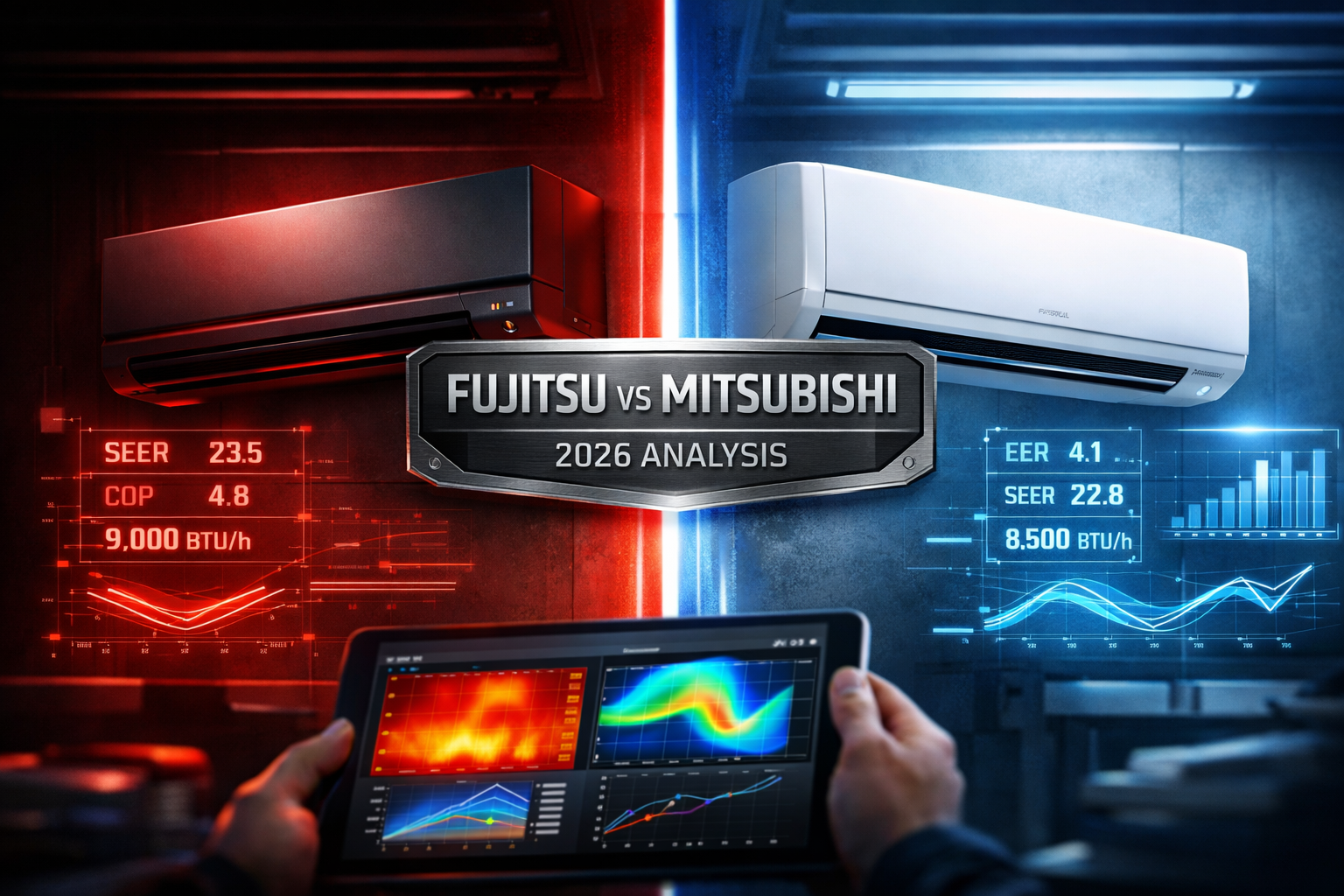
The spec sheet tells an interesting story: Fujitsu wins on raw efficiency numbers (SEER2 33.1 vs 30.5, HSPF2 14.2 vs 13.6). Mitsubishi wins on noise and US service network. At the flagship single-zone level, Fujitsu’s built-in Wi-Fi and base pan heater as standard features are genuine advantages over the Mitsubishi at similar price points.
Noise: The Difference You Can Actually Hear
The noise comparison is one area where the numbers translate directly to lived experience — but require context to interpret correctly.
The difference between Mitsubishi at 19 dB(A) and Fujitsu at 21 dB(A) is 2 decibels. The human ear perceives a 3 dB change as approximately doubling or halving perceived loudness. A 2 dB difference is below the threshold of noticeable difference for most people in normal listening conditions. In an actual bedroom with ambient noise from traffic, air circulation, and a sleeping partner, you will not notice the difference.
Where the noise numbers genuinely matter:
- Recording studios or podcast rooms — where true acoustic silence is required. Here Mitsubishi’s 19 dB minimum matters.
- Home theater rooms — same reasoning.
- Master bedrooms for light sleepers — marginal difference, but worth considering if noise sensitivity is documented.
For a standard living room, bedroom, or office: both units are functionally silent at low fan speeds. Do not let a 2 dB spec sheet difference be your deciding factor unless you have a specific acoustic use case.
Warranty: What the Fine Print Actually Says
Both brands advertise “up to 12-year warranties” and both require certified contractor installation to achieve them. The practical difference is in how easy it is to find that certified contractor in your area.
Mitsubishi Diamond Contractor Program
Mitsubishi’s Diamond Contractor designation requires contractors to complete factory training, maintain minimum install volumes, and pass annual recertification. With 3,000+ US locations, you can almost always find one within a reasonable distance. The 12-year warranty is activated by online registration within 90 days of installation — a step many homeowners miss. Set a calendar reminder the day of installation.
Fujitsu Elite Contractor Program
Fujitsu’s Elite Contractor network follows a similar structure but has lower density in the US. The 12-year warranty also requires licensed contractor installation and registration. One important difference: Fujitsu’s base Halcyon/Airstage XLTH warranty starts at 7/5 years with registration by a standard licensed contractor — not requiring Elite status. This is slightly more flexible than Mitsubishi’s structure.
DIY Installation: The Hard Reality
Both brands require professional installation with EPA 608 certification, a vacuum pump, and manifold gauges. Neither offers a pre-charged quick-connect line set system like MrCool DIY. Attempting to install either yourself will void the warranty on day one.
If you are committed to DIY installation, the correct decision tree is:
- Mild to moderate climate (zones 3-5, rarely below 5°F): MrCool DIY 5th Gen — pre-charged, genuine DIY support, good SEER2 ratings.
- Cold climate requiring low-temp performance: There is no good DIY option. Professional installation of a Mitsubishi H2i or Fujitsu XLTH is the correct answer. The performance gap between these and any DIY system is too large to justify DIY in a cold climate.
Case Study: Minneapolis Homeowner, 1,200 sq ft Ranch
Background: A homeowner in South Minneapolis (climate zone 6B, design day temperature -12°F) replaced electric baseboard heating in a 1,200 sq ft 1960s ranch with two mini split systems in adjacent halves of the house. Due to a limited budget for a full house system, she split the job: Mitsubishi MSZ-GL12NA H2i in the primary living area and Fujitsu ASU12RLS3Y XLTH in the bedroom wing. Both were installed by the same contractor in October 2023. Both were correctly sized using Manual J calculations for the actual zones.
What the homeowner reported after one full heating season:
Key engineering observation: The Mitsubishi H2i’s shutdown at -14°F (1°F below its rated limit) was expected and not a malfunction. The system activated an electric resistance backup heater as designed. Over the entire heating season, this happened on exactly 3 nights totaling approximately 9 hours. The electric backup cost was negligible — roughly $4 in additional electricity. For 99.7% of the heating season, the Mitsubishi performed identically to the Fujitsu.
The honest conclusion from this case study: In Minneapolis, Fujitsu’s -15°F rating provides a genuine but very narrow practical advantage — roughly 3-9 hours per year of additional heat pump operation without backup. For homeowners in climate zone 6A/6B, the choice between these brands should be driven by price, contractor availability, and warranty terms — not by the 2°F difference in rated minimum temperature.
Which Brand Wins Your Specific Situation
Final Verdict
Choose Mitsubishi H2i if: You are in a rural area with limited Fujitsu service coverage, you need a complex multi-zone system, design aesthetics of the indoor unit matter, or you want the deepest US parts and service network available for a premium brand.
For most US homeowners in climate zones 4-6: The real-world performance difference between these two brands is smaller than the installer quality difference. A Fujitsu unit installed by a mediocre contractor will underperform a Mitsubishi installed by an excellent Diamond Contractor, and vice versa. Choose your installer first, then let them recommend the brand they know best.
Frequently Asked Questions
This article is based on manufacturer datasheet specifications, NEEP cold-climate heat pump performance data, ASHRAE engineering principles, and field observations. Specifications are current as of Q1 2026 and may change with model updates. Installed price ranges are US market estimates and vary significantly by region, contractor, and project complexity. Affiliate links in this article may earn MiniSplitSizer a small commission at no cost to you. MiniSplitSizer is not sponsored by or affiliated with Fujitsu General or Mitsubishi Electric.