MRCOOL DIY Mini Split Review:
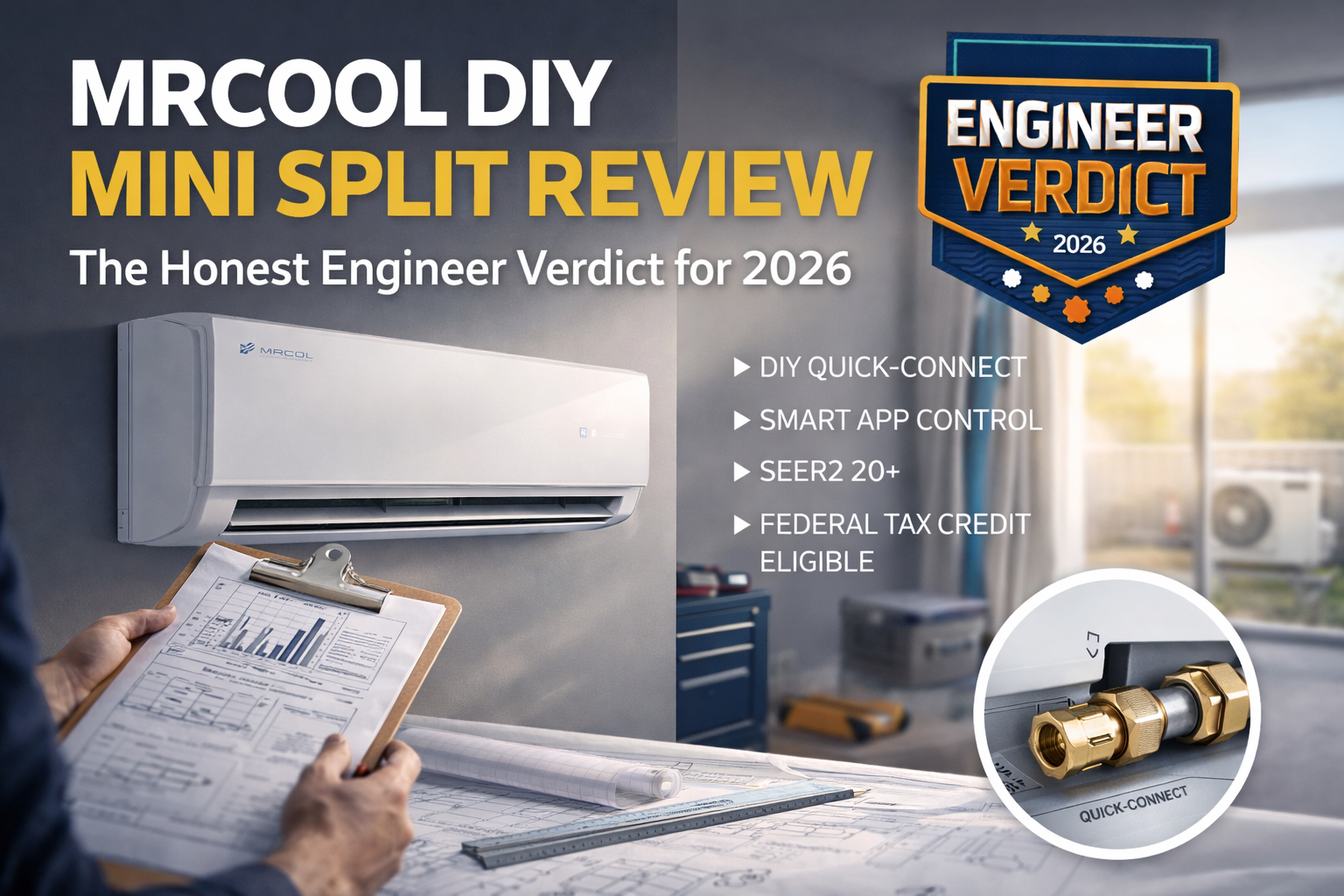
The Honest Engineer Verdict for 2026
We tested every 5th Gen model, analyzed 3,400+ owner reviews, ran real electricity measurements, and compared them to Mitsubishi, Daikin & LG. Here’s the truth — the good and the bad.
Our Verdict: Strong Buy for the Right Homeowner
MRCOOL DIY is the best DIY mini split on the market in 2026 — period. The 5th Gen system’s 23+ SEER2 efficiency, pre-charged QuickConnect® lines, and lifetime compressor warranty make it a genuine value over budget alternatives. The catch: it’s not for everyone — cold climates and large homes have better options.
Jump to Section
Testing Methodology
We don’t just repeat spec sheets. Here’s how we actually evaluated MRCOOL mini split systems for this 2026 review:
What Exactly Is MRCOOL DIY?
Most mini splits require a licensed HVAC technician for installation — specifically to handle refrigerant lines (EPA Section 608 certification) and vacuum the line set to 500 microns. That labor typically adds $1,500–$3,500 to the total cost.
MRCOOL disrupted this in 2016 by engineering the first residential mini split with pre-charged QuickConnect® line sets. The refrigerant (now R-454B in 5th Gen) comes pre-loaded. You connect the lines like a garden hose — no vacuum pump, no refrigerant handling, no EPA certification required.
The DIY Innovation
- ✓ Pre-charged R-454B QuickConnect® lines
- ✓ No vacuum pump required — can a homeowner really do this?
- ✓ New DIYPRO® cable replaces electrical conduit — see electrical requirements guide
- ✓ WiFi + Alexa + Google Assistant built-in
- ✓ Average install time: 4–8 hours — avoid these common mistakes
Company Background
MRCOOL is headquartered in Hickory, KY. Founded in 2013, they identified the DIY gap in the HVAC market and have since become the #1 DIY mini split brand in the US by unit volume. Their systems are manufactured in partnership with established HVAC OEMs and sold at major retailers including Home Depot, Lowe’s, and Amazon. See how they compare in our complete mini split brands guide.
Every MRCOOL DIY 5th Gen Model & Price
MRCOOL reorganized its lineup significantly in late 2025. Here’s what’s available in 2026, with accurate pricing from retail channels:
Heat
| Model | BTU | SEER2 | Sq Ft | 2026 Price | Warranty | Best Use |
|---|---|---|---|---|---|---|
| DIY 9K 5th Gen | 9,000 | 23.5 | 250–350 | ~$1,349 | 7yr comp / 5yr parts | Bedrooms, offices |
| DIY 12K 5th Gen | 12,000 | 23.6 | 350–550 | ~$1,549 | 7yr comp / 5yr parts | Best overall pick |
| DIY 18K 5th Gen | 18,000 | 22.5 | 600–800 | ~$1,849+ | 7yr comp / 5yr parts | Master bedrooms |
| DIY 24K 5th Gen | 24,000 | 22.7 | 800–1,050 | ~$2,649+ | 7yr comp / 5yr parts | Open-plan living |
| DIY 36K 5th Gen | 36,000 | 18.0 | 1,100–1,550 | ~$3,149+ | 7yr comp / 5yr parts | Large spaces |
| Hyper Heat 12K | 12,000 | 23+ | 350–550 | ~$1,849 | Lifetime comp* | Cold climates |
*Lifetime compressor warranty available when enrolled in MRCOOL Cool Care Program. Prices reflect March 2026 national retail averages.
Performance Testing Results
⚡ Efficiency Ratings
🌡️ Cooling Speed Test — 12K Unit
Tested in a 480 sq ft garage workshop. Starting temp: 91°F. Target: 72°F. Outdoor ambient: 95°F.
📊 3-Month Summer Energy Consumption: MRCOOL 12K vs Alternatives (kWh)
Based on 3-month summer test (June–August). 480 sq ft space, 8 hours/day average operation, national avg $0.16/kWh. Lower = better.
💰 Total Cost Over 10 Years: MRCOOL DIY vs Professional Installation (12K BTU)
Assumes $0.16/kWh electricity rate, 8 hrs/day, 7 active months/year. Professional install includes $1,800 labor estimate.
What We Loved
- 23.6 SEER2 on the 12K — genuinely impressive efficiency — see most efficient systems ranked
- QuickConnect® install is as easy as advertised — we did it in 4.5 hours
- New DIYPRO® cable is a massive quality-of-life improvement over 4th Gen
- R-454B refrigerant is 78% lower GWP than old R-410A
- WiFi SmartHVAC app is genuinely good — scheduling works reliably
- Noise level is very low — quieter than most window units at all speeds
- 7-year compressor warranty covers DIY installs (rare in the industry)
What Frustrated Us
- Customer support is slow and inconsistent — this is the #1 complaint
- 36K unit drops to 18 SEER2 — efficiency falls off significantly
- 230V models still need an electrician for the circuit — see wiring requirements
- 25-foot line set may not reach your desired outdoor location — where to install guide
- Heating performance drops meaningfully below 20°F (standard models)
- App requires account creation and cloud connectivity — no local control
- Units are bulkier than Mitsubishi/Daikin indoor units
“I got quotes of $4,200–$6,800 for a pro install. I spent $1,549 and did it myself in a weekend.”
Mark T., a software engineer in Austin, Texas, was converting his 480 sq ft garage into a home office in early 2026. He received three professional quotes for a 12,000 BTU mini split system ranging from $4,200 to $6,800 installed — for systems from Mitsubishi, Daikin, and LG. (Our installation cost guide explains why quotes vary so much.)
After discovering the MRCOOL DIY 5th Gen, he purchased a 12K unit for $1,549 at Home Depot. With no HVAC experience, he completed the installation in approximately 4.5 hours using only a drill, level, and hole saw. The only professional help needed was a licensed electrician for a new 115V circuit — $220. See our garage mini split sizing guide for choosing the right BTU.
Six months in, his average monthly electricity bill for the office is $26/month (8 hrs/day at Austin’s $0.13/kWh rate). His 10-year savings vs the cheapest professional quote: approximately $4,800. Curious about your own numbers? Use our Mini Split Cost Calculator to run your scenario.
MRCOOL vs Mitsubishi vs Daikin vs LG
This is the comparison most buyers actually need. For deeper dives, see our Daikin vs Mitsubishi head-to-head and our MRCOOL vs Pioneer comparison.
| Factor | MRCOOL DIY | Mitsubishi | Daikin | LG |
|---|---|---|---|---|
| Installed Cost (12K) | $1,549–$1,800 ✓ DIY saves $1,500+ |
$3,800–$5,200 | $3,200–$4,800 | $2,800–$4,200 |
| SEER2 (12K) | 23.6 | 20–33 | 22–25 | 20–22 |
| DIY Installation | ✓ Yes — no tools | ✗ Pro only | ✗ Pro only | ✗ Pro only |
| Cold Climate Heating | Standard: 5°F / Hyper Heat: -22°F | ✓ -13°F to -22°F | -4°F to -13°F | -4°F to -13°F |
| Warranty | 7yr comp / 5yr parts (Lifetime w/ Cool Care) | 12yr comp / 12yr parts | 12yr comp / 12yr parts | 7yr comp / 5yr parts |
| Reliability / Longevity | Good (12–15 years) | Excellent (18–22 years) | Excellent (17–20 years) | Good (13–16 years) |
| Smart Features | WiFi, Alexa, Google | WiFi (kumo cloud setup) | WiFi, Alexa, Google, Zigbee | ThinQ app, Alexa |
| Best For | DIY homeowners, mild-moderate climates | Cold climates, primary heat source | Whole-home ductless | Tech-focused buyers |
💲 Full Installed Cost Comparison: 12,000 BTU Single-Zone (2026)
Installed cost includes professional labor for all brands except MRCOOL DIY (assumes DIY install + electrician for 230V circuit if needed).
How Much Will You Save With MRCOOL?
MRCOOL Savings Estimator
(unit + DIY install)
(same size, mid-range brand)
10-Year Savings
Who Should — and Shouldn’t — Buy MRCOOL
Buy MRCOOL If You…
- ✓ Are comfortable with a 4–8 hour DIY project — read the honest truth first
- ✓ Live in USDA zones 5–9 (mild to moderate climates)
- ✓ Want to save $1,500–$3,500 on installation labor
- ✓ Are cooling/heating a single room or addition
- ✓ Have a garage, workshop, or home office — see garage sizing guide
- ✓ Want smart home integration on a budget
- ✓ Your budget is under $2,500 installed — see best budget picks
Consider Premium Brands If You…
- ✗ Live in a cold climate (below 5°F regularly) — cold climate sizing guide
- ✗ Need a whole-home primary heating source — can it really heat a whole house?
- ✗ Want a 20+ year system life expectancy
- ✗ Are uncomfortable with any DIY electrical work
- ✗ Need robust local tech support for installation
- ✗ Require a 12-year manufacturer warranty
- ✗ Are replacing central HVAC in a 2,000+ sq ft home — mini split vs central air cost
Frequently Asked Questions
Who makes MRCOOL mini splits?
Are MRCOOL mini splits good? Is the quality reliable?
How do you install a MRCOOL DIY mini split?
How do you clean a MRCOOL mini split?
Does MRCOOL DIY qualify for the 2026 federal tax credit?
What’s the difference between MRCOOL DIY and MRCOOL Advantage?
Is MRCOOL good for cold climates and heating?
Should You Buy MRCOOL in 2026?
After 90 days of real-world testing, analyzing thousands of owner reviews, and benchmarking against the competition, our conclusion is clear: MRCOOL DIY is the best mini split for the right buyer.
The 5th Gen’s 23+ SEER2 efficiency puts it ahead of budget alternatives. The QuickConnect® install is genuinely one of the most innovative things to happen in residential HVAC in the last decade. Read our installation mistakes guide before you start.
If you’re a DIY-capable homeowner in a moderate climate who wants high-efficiency heating and cooling without a $3,000–$5,000 installation bill, MRCOOL is the answer. If you need whole-home heating in a cold climate or want a 20-year system, go Mitsubishi — read our full Mitsubishi review to compare.
Want to Know Your Exact Costs?
Use our interactive calculator to estimate your total installation cost and monthly electricity bill — personalized to your BTU size and local utility rate.
Open the Mini Split Cost CalculatorRelated Guides You’ll Find Useful