Daikin vs Mitsubishi Mini Split:
Engineering Comparison (2026)
As an HVAC engineer, the most common question I get from homeowners ready to invest in a premium ductless system is: “Should I buy a Daikin or a Mitsubishi?”
It is the classic heavyweight title fight of the HVAC world. Both are Japanese engineering giants. Both dominate the global market. And both offer exceptional, 12-year warrantied inverter technology. But under the hood, their compressor designs, cold-weather limits, and pricing structures are different.
Quick Comparison Table (2026 Specs)
Here is how the two premium titans stack up at a glance:
| Feature | Mitsubishi Electric | Daikin |
|---|---|---|
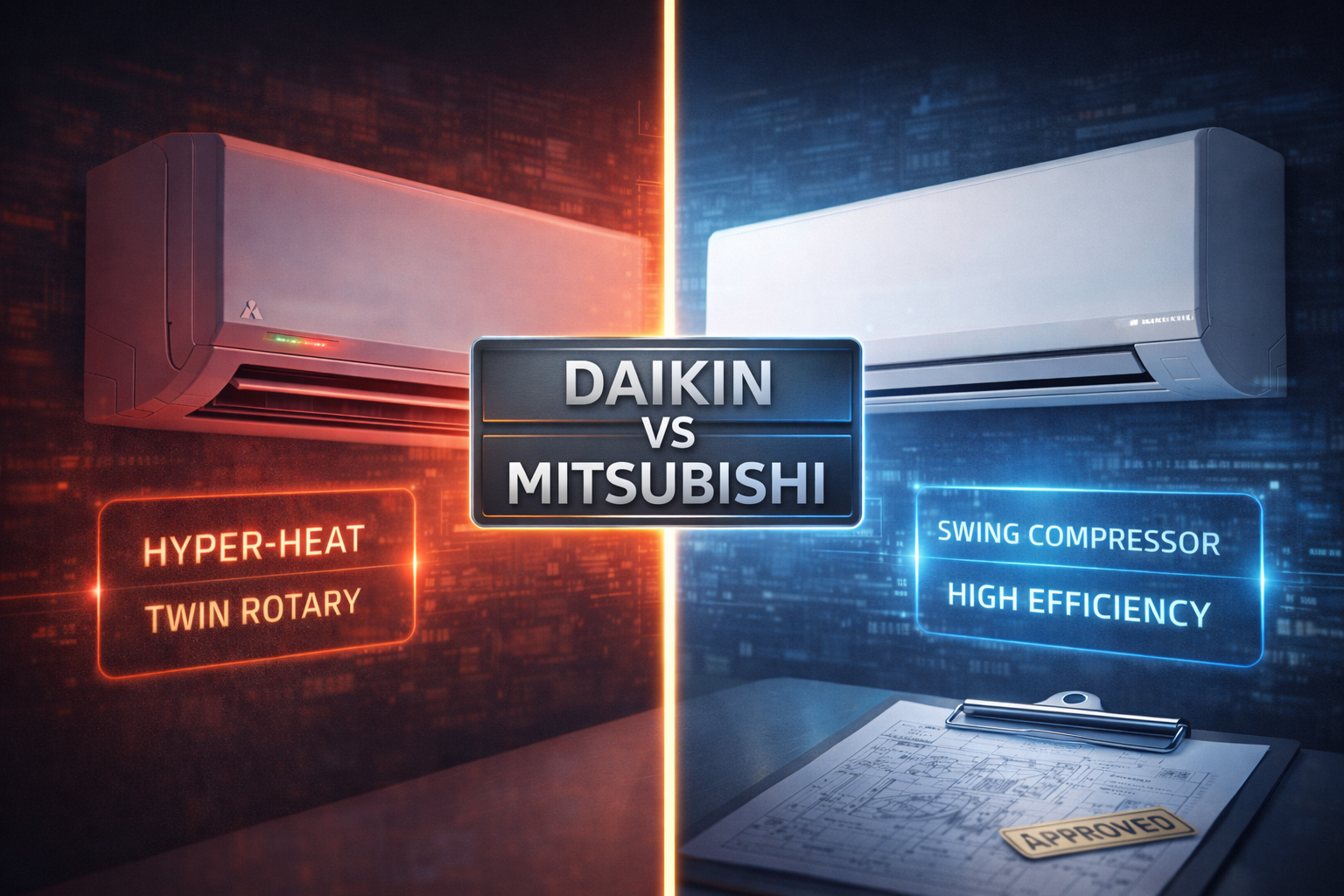
| Compressor Tech | Inverter Driven (Twin Rotary) | Inverter Swing Compressor |
| Max SEER2 Rating | Up to 33.1 (FS Series) | Up to 26.1 (Quaternity/LV) |
| Extreme Cold Tech | Hyper-Heating (H2i) | Aurora Series |
| Indoor Noise (Low) | ~19 dB(A) | ~19 dB(A) |
| Max Warranty | 12 Years (Diamond Contractor) | 12 Years (Comfort Pro) |
| Best For… | Extreme climates & absolute premium builds | High efficiency at a slightly better price point |
Compressor Technology (Engineering Breakdown)
The compressor is the heart of any mini split. Both brands use variable-speed “inverter” technology (meaning they don’t just turn on and off; they ramp up and down smoothly). However, their mechanical approaches are different.
Mitsubishi: Twin Rotary
Mitsubishi relies on highly refined twin-rotary compressors in their larger units. These are built like tanks, capable of maintaining high pressures needed for extreme heating. They are legendary for running 15+ years without mechanical failure.
Daikin: Swing Compressor
Daikin patented the “Swing Compressor” for its smaller residential units. By integrating the blade and the roller, Daikin essentially eliminated internal friction and refrigerant leakage. This makes Daikin compressors incredibly quiet and highly efficient at low speeds.
Performance in Cold Climates
If you live in the Northeast US or Canada, heating capacity is your #1 concern.
- The Mitsubishi Advantage: Mitsubishi’s Hyper-Heating (H2i) technology is the undisputed king of cold weather. An H2i unit can deliver 100% of its rated heating capacity at 5°F (-15°C) and continues producing heat down to -13°F (-25°C) or lower.
- The Daikin Contender: Daikin’s Aurora Series is spectacular, offering 100% heating capacity at 5°F. However, in the most extreme sub-zero deep freezes, HVAC professionals generally lean slightly toward Mitsubishi’s robust defrost cycle management.
Live in a freezing zone? Make sure you read our critical guide: Mini Split Sizing for Cold Climates to prevent your system from freezing over.
Energy Efficiency Comparison
Both brands will drastically reduce your electric bill compared to central air or window units, but who wins the spec sheet battle?
Mitsubishi holds the crown for absolute maximum efficiency. Their flagship FS Series hits an astonishing 33.1 SEER. Daikin’s top units hover around the 24-26 SEER mark. However, keep in mind that a 33 SEER Mitsubishi unit costs a premium. In the standard mid-tier (18-20 SEER range), both brands are neck-and-neck in real-world kilowatt usage.
See how these specs translate to actual dollar savings in our list of the Most Energy Efficient Mini Split Systems.
Installation & Service Network
A mini split is only as good as the technician who installs it. If it is installed poorly, a $5,000 Mitsubishi will perform worse than a $1,000 budget brand.
Mitsubishi Diamond Contractors
Mitsubishi has the most extensive, rigorous certification network in the US. If you use a Diamond Contractor, your parts and compressor warranty extends to 12 years. Parts availability in North America is generally excellent.
Daikin Comfort Pros
Daikin also offers a 12-year warranty when installed by a certified Comfort Pro. As the largest HVAC manufacturer in the world (they own Goodman and Amana), their distribution footprint is massive, though some local techs are still more familiar with Mitsubishi.
Cost Comparison
Here is the truth: Mitsubishi carries a “Brand Tax.”
Because Mitsubishi is widely considered the absolute pinnacle of the market, contractors often charge a premium for the equipment. A 12,000 BTU Mitsubishi system will typically quote $300 to $800 higher than a comparable Daikin system, even when installation labor is identical.
Want to see the exact invoice breakdown? Read our Mitsubishi Mini Split Cost & Installation Breakdown to ensure you aren’t being overcharged.
Which One Should You Choose? (The Final Verdict)
Your decision should be based on your specific scenario, not just brand loyalty. Here is my engineering recommendation:
The Brand Doesn’t Matter If The Size Is Wrong
Whether you buy a Daikin or a Mitsubishi, if the unit is too big or too small, it will fail prematurely and fail to dehumidify your home. Stop guessing.
Use Our Free BTU CalculatorFrequently Asked Questions
Is Daikin or Mitsubishi better for cold climates?
Mitsubishi’s Hyper-Heating (H2i) technology generally outperforms Daikin in extreme sub-zero temperatures (down to -13°F or lower). However, Daikin’s Aurora series is a very strong and slightly cheaper alternative for moderately cold climates.
Which mini split is quieter, Daikin or Mitsubishi?
Both are exceptionally quiet. Mitsubishi indoor units can drop to around 19 dB(A), while Daikin units operate around 19-22 dB(A). To the human ear, both are essentially silent on their lowest fan settings, quieter than a whisper.
Are Daikin and Mitsubishi the same company?
No. They are two separate, fiercely competitive Japanese multinational companies. Both are considered the absolute top tier of the global HVAC and ductless mini split industry.
Which mini split brand is more expensive?
Mitsubishi is typically the most expensive mini split brand on the market in terms of upfront equipment costs. Daikin is also a premium brand but often comes in slightly cheaper for comparable mid-tier models.