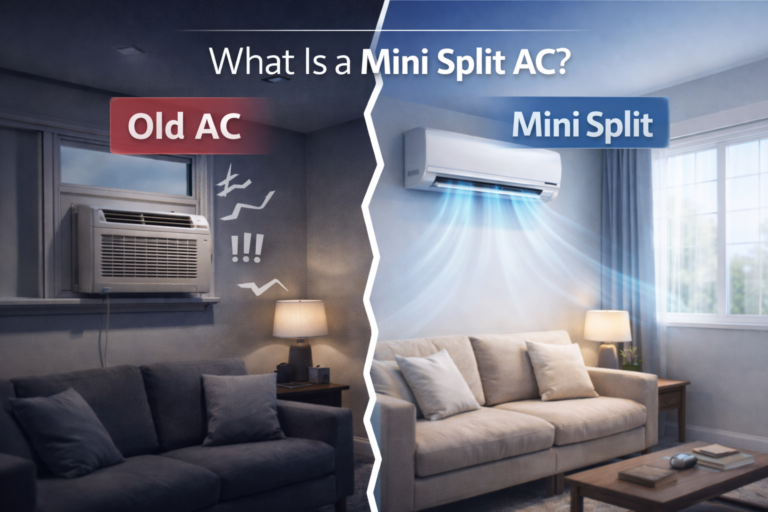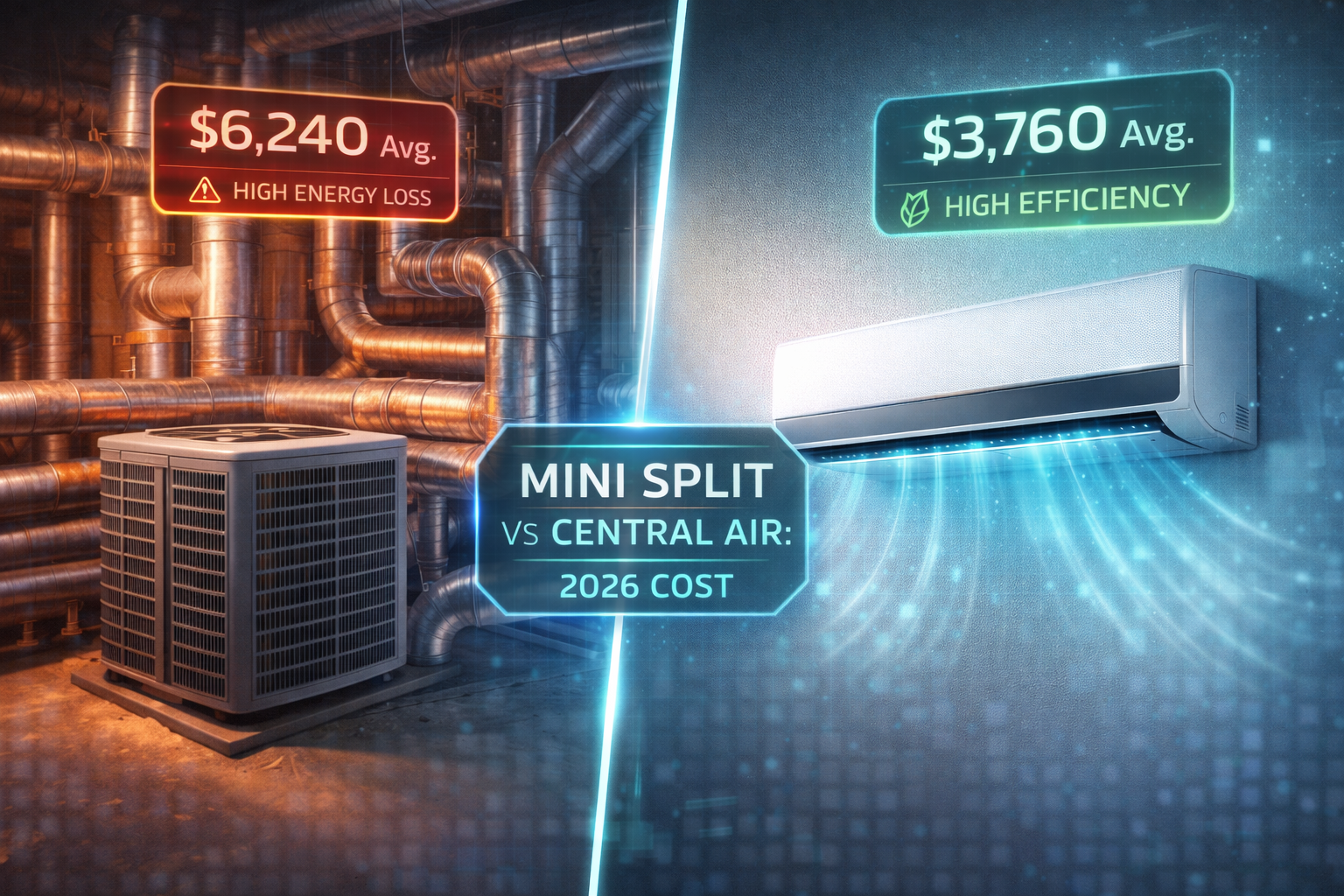
Is a Mini Split Cheaper Than Central Air in 2026?
(Real Cost Breakdown)
You’re replacing your HVAC system.
One contractor says, “Go central, it’s better for the whole house.”
Another contractor says, “Mini splits will save you thousands.”
Who’s right in 2026?
In this guide, I’ll break down installation costs, electricity usage, maintenance, and long-term ownership costs using real 2026 pricing data. No generic advice—just field-tested energy comparisons to help you make the right financial decision.
The Quick Answer
- Upfront Cost: Mini splits are cheaper for small homes and additions.
- Installation: Central air is cheaper for full-house replacements only if good ductwork already exists.
- Monthly Electricity: Mini splits are 15–35% more efficient.
- Long-Term Cost: Highly dependent on your home’s layout and insulation.
Bottom Line: In most 1–2 zone applications, mini splits are cheaper in 2026. In large, already-ducted homes, central air can still win the upfront cost battle.
Installation Cost Comparison (2026 Realistic Ranges)
When comparing the mini split vs central air cost 2026, you must separate the equipment cost from the labor. Here are the real installation estimates based on 2026 pricing trends.
Mini Split Costs
- 1 Zone (Single Room): $3,000 – $5,500
- 2–3 Zones (Partial Home): $6,000 – $12,000
- Whole Home Multi-Zone: $12,000 – $20,000+
Factors affecting price: Line set length, electrical panel upgrades, and brand tier.
Central Air Costs
- If ductwork exists: $5,000 – $9,000
- If new ducts required: $10,000 – $18,000+
Electricity Cost Comparison (Where Mini Splits Shine)
If you are wondering, “is ductless cheaper than central air?”, the answer almost always lies in your monthly utility bill.
Why Mini Splits Use Less Electricity:
- Inverter Compressors: They ramp up and down smoothly like a dimmer switch, rather than blasting at 100% capacity and shutting off like central ACs.
- No Duct Losses: According to the Department of Energy, duct leaks account for 20–30% of energy waste in central systems. Mini splits deliver air directly to the room.
- Zoned Cooling: Why cool empty guest bedrooms? Mini splits let you turn off zones you aren’t using.
Engineering Note
In field measurements, properly sized mini splits often consume 25% less kWh than comparable SEER central systems. For a deep dive, see our exact mini split electricity cost breakdown.
Real Example: 2,000 Sq Ft Home (6-Month Cooling Season)
Annual Difference: $240 – $600 in savings
Efficiency Ratings (The Technical Truth)
In 2023, the DOE updated testing standards to SEER2 and HSPF2 to reflect real-world duct pressures. Here is how the technologies stack up in 2026:
-
MSMini Splits: SEER2 18 – 28 Ultra-high efficiency. Almost all energy drawn is converted directly to cooling.
-
CACentral Air: SEER2 14 – 18 Standard efficiency. Reaching 20+ SEER2 in central air is possible but astronomically expensive.
Maintenance & Repair Costs
We must maintain an honest tone here: Mini splits are incredibly efficient, but they are not maintenance-free.
Central Air Maintenance
- Requires expensive duct cleaning every 3-5 years.
- Blower motor and evaporator coil failures are common.
- Parts are generic and widely available.
Mini Split Maintenance
- Mechanically simpler (no ducts).
- Indoor heads require frequent, meticulous filter and blower wheel cleaning to prevent mold.
- Warning: The PCB (computer boards) inside mini splits are complex and expensive to replace if damaged by power surges.
Comfort & Performance Comparison
When evaluating mini split vs central air pros and cons, comfort is just as important as cost.
Mini Splits
- Superior room-by-room zoning.
- No hot/cold imbalances across floors.
- Perfect for home additions or garages.
- Wall units are visible in the room.
Central Air
- Invisible aesthetics (only vents show).
- Whole-home uniform airflow.
- Better familiarity for home resale.
- Cools empty rooms, wasting energy.
The Final Decision Framework
Central Air is Cheaper When:
- 🔹 You have a large home (3,000+ sq ft).
- 🔹 Your existing ductwork is in excellent condition.
- 🔹 You need full-home, uniform cooling constantly.
Mini Splits are Cheaper When:
- 🔹 Your home has no existing ductwork (Boilers/Radiators).
- 🔹 You are cooling an addition or garage.
- 🔹 You live in an area with high electricity rates.
- 🔹 You are an energy-conscious homeowner who wants zoning.
Wait! Don’t Buy Anything Yet.
Incorrect sizing increases operating costs by up to 25% and causes early system failure. Before choosing a system, calculate your exact room-by-room thermal load.
Use Our Free Manual J Lite CalculatorMini Split vs Central Air: Quick Comparison
| Category | Mini Split | Central Air |
|---|---|---|
| Install Cost | Lower (Small homes/No ducts) | Lower if ducts already exist |
| Electricity | 15–35% lower | Higher (Due to duct loss & non-inverter) |
| Zoning | Yes (Room by room) | No (Requires expensive dampers) |
| Lifespan | 12–20 yrs | 15–20 yrs |
| Maintenance | Moderate (Frequent filter cleaning) | Higher (Duct cleaning, major parts) |
Frequently Asked Questions
Is a mini split cheaper long term?
Yes, in most scenarios without existing ductwork. Mini splits use 15-35% less electricity due to inverter technology and the elimination of duct losses, resulting in significant long-term utility savings.
Does central air increase home value more?
Historically, central air offered a slightly better ROI for whole-home resale value due to aesthetic familiarity. However, in 2026, premium multi-zone mini split systems are highly valued by energy-conscious buyers seeking zoned comfort.
What about heating?
Mini splits are essentially highly efficient heat pumps. They provide both cooling and heating, even in sub-zero temperatures (if you buy a Hyper-Heat model). Central air typically requires a separate gas furnace to provide winter heating.
Which lasts longer?
Both systems generally last 15 to 20 years. Central air systems may require expensive ductwork repairs over time, while mini splits require more frequent indoor blower wheel cleanings to maintain their lifespan.
Is a mini split good for an entire house?
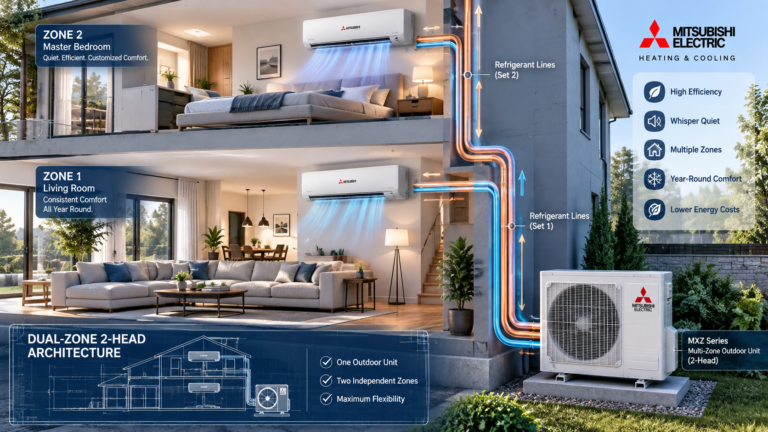
Yes. A multi-zone mini split system can efficiently heat and cool an entire house by running multiple indoor heads off a single large outdoor compressor, allowing for perfect room-by-room temperature control.