Sunroom Mini Split Guide (2026): Why Standard Sizing Fails & What to Buy
Quick Answer:
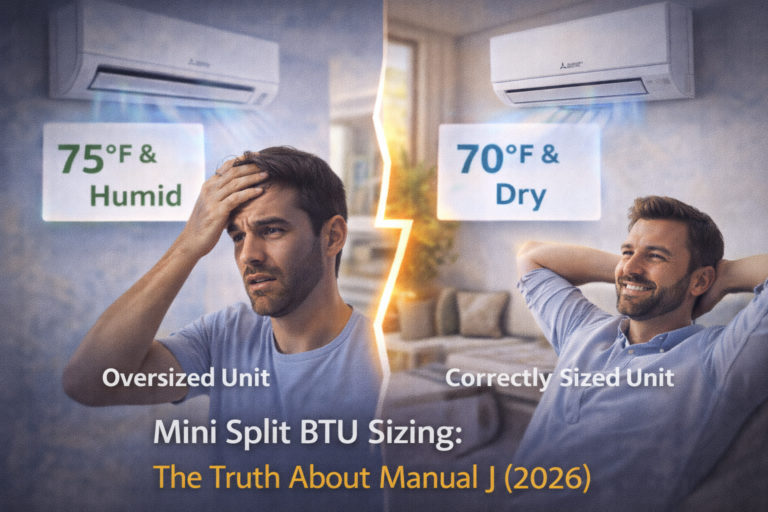
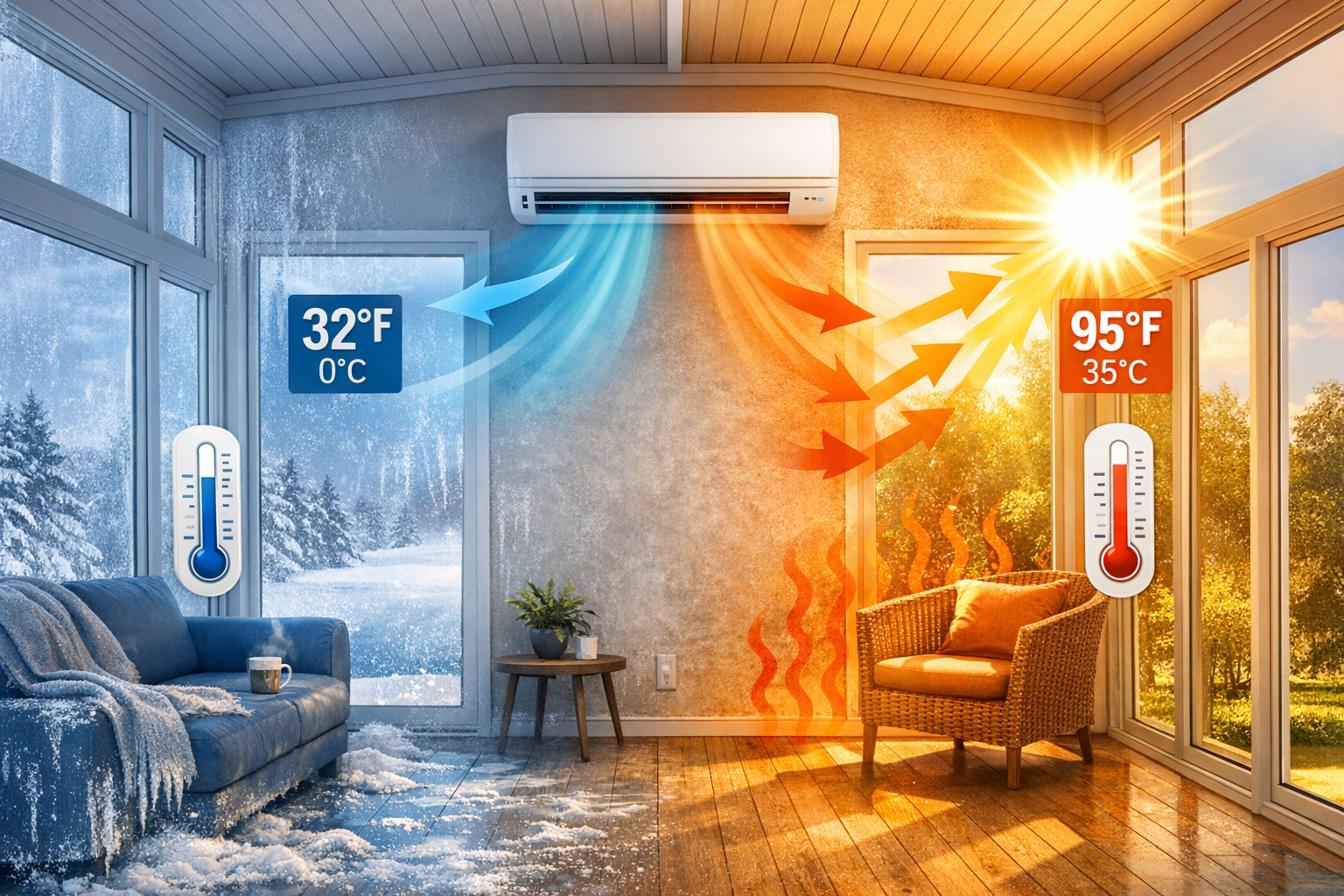
Sunrooms need 2–4× more BTUs than standard rooms due to massive glass heat loss and solar gain.
Most sunrooms between 250–350 sq ft require 12,000–18,000 BTUs, not 6,000.
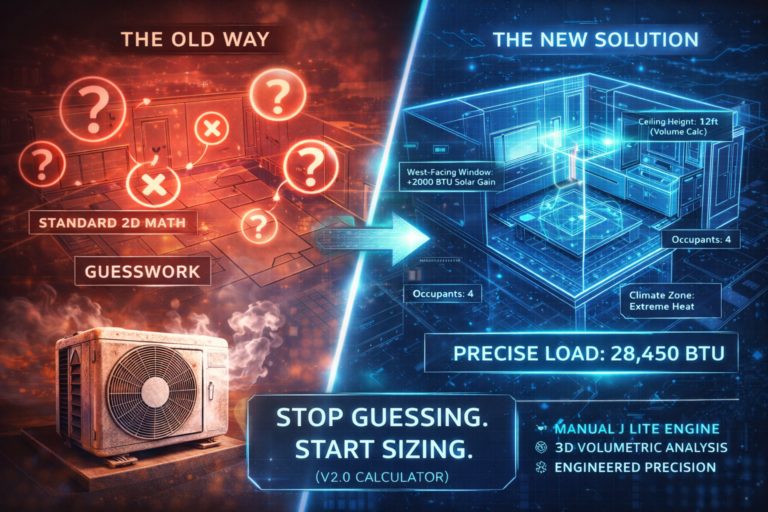
👉 Use our Mini Split Sizer to calculate your exact load in seconds.
The residential sunroom represents a unique architectural paradox. Designed to bridge the visual and psychological gap between the interior sanctuary and the exterior environment, it is defined by its transparency. Yet, in the domain of building physics, this transparency constitutes a catastrophic breach of the thermal envelope.
Unlike standard residential construction, where the primary objective is to resist heat transfer through opaque, insulated assemblies, the sunroom invites solar radiation while simultaneously offering negligible resistance to conductive heat flow. This fundamental contradiction creates a volatile thermal zone that defies standard HVAC (Heating, Ventilation, and Air Conditioning) sizing methodologies and operational logic.
For the homeowner and the HVAC engineer alike, the sunroom is not merely another room; it is a dynamic energy anomaly. The successful conditioning of this space requires a departure from traditional central air strategies, which rely on static load calculations and uniform air distribution. Instead, the solution lies in the localized, variable-capacity performance of the ductless mini-split heat pump.
To understand why this technology is not just an option but the only viable solution for modern sunrooms, one must first deconstruct the complex physics of heat transfer in high-glazing environments.
1. The Physics of Heat Transfer in Sunrooms
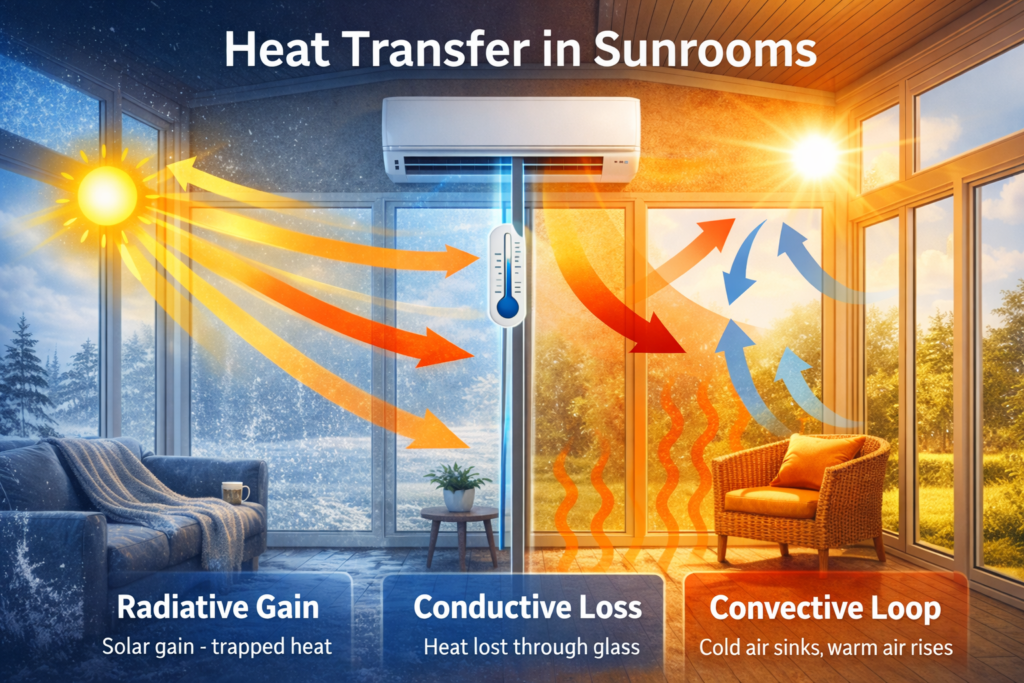
1.1 The Triad of Heat Transfer in Glazing
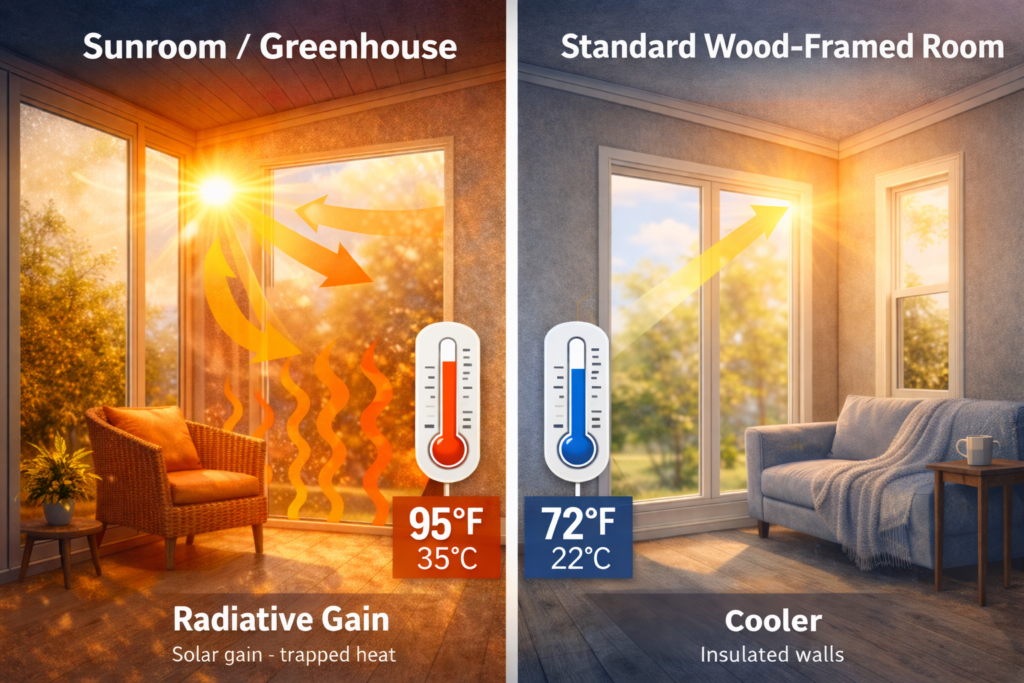
In a standard wood-framed room, the thermal load is dominated by conduction through walls that possess substantial thermal mass and resistance (R-values ranging from R-13 to R-30). In a sunroom, where glass constitutes 60% to 90% of the wall area, the thermal dynamics shift radically.
1.1.1 Radiative Gain and the Greenhouse Effect
The most potent force in a sunroom is solar radiation. Sunlight reaches the earth’s surface primarily as short-wave electromagnetic radiation. Glass—whether single, double, or triple-paned—is largely transparent to these short wavelengths. This allows solar energy to penetrate the building envelope unimpeded.
Once inside, this radiation strikes opaque surfaces such as flooring, furniture, and drywall. These materials absorb the short-wave energy and re-emit it as long-wave infrared radiation (thermal energy).
Crucially, glass is opaque to long-wave radiation. The thermal energy is effectively trapped inside the enclosure, creating the classic greenhouse effect.
In summer, this can cause internal temperatures to spike 30°F to 50°F above the ambient outdoor temperature within hours. A sunroom facing south or west can accumulate solar gains exceeding 20,000 BTUs per hour on a clear day, a load that rivals the cooling requirements of an entire standard residential floor.
1.1.2 Conductive Hemorrhage
While radiation dominates the summer cooling load, conduction drives the winter heating load.
Conduction is the molecule-to-molecule transfer of kinetic energy through a material. The rate of transfer is dictated by the U-factor (U), which is the inverse of the R-value (U = 1/R).
- Standard Wall (2×6, R-20): U ≈ 0.05
- Single Pane Glass (R-0.9): U ≈ 1.1
- Standard Double Pane (R-2.0): U ≈ 0.5
This differential indicates that a square foot of single-pane glass loses heat 22 times faster than a square foot of insulated wall. Even high-performance double-pane glass loses heat 10 times faster.
Consequently, a sunroom acts as a massive thermal fin, rapidly dissipating heat to the exterior environment. This creates a load density (BTUs required per square foot) that is vastly higher than the rest of the home, rendering standard rule-of-thumb sizing useless.
1.1.3 Convective Looping and Stratification
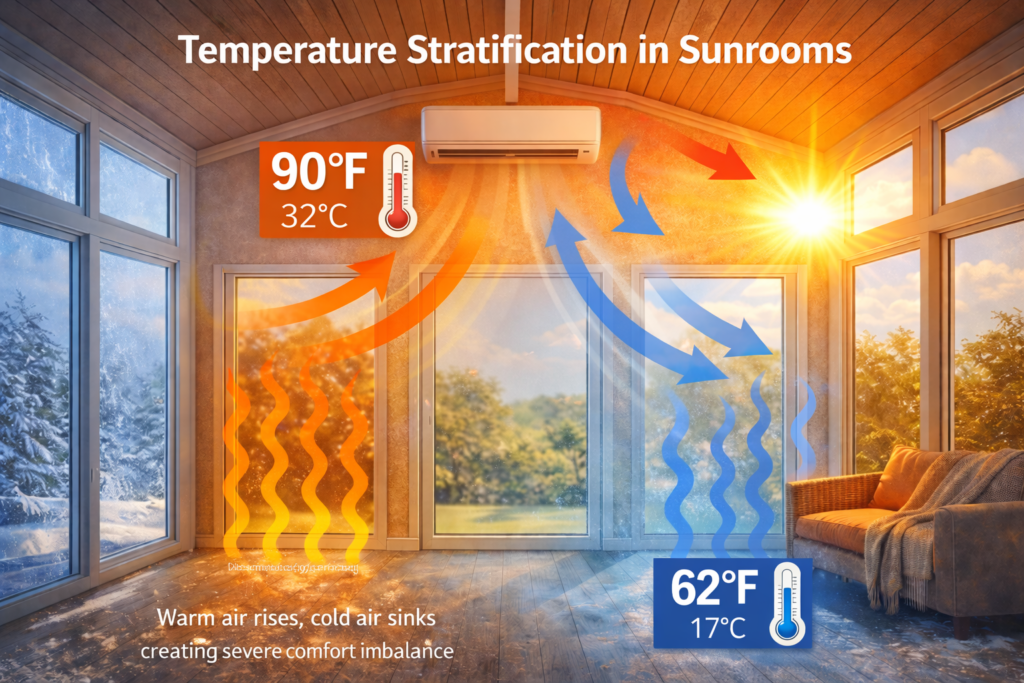
The third mechanism, convection, manifests uniquely in sunrooms.
As warm air inside the room contacts the cold glass surface in winter, it cools rapidly. This denser, cold air slides down the face of the glass, pooling at the floor level. Simultaneously, warm air rises to the ceiling, especially in vaulted sunrooms.
This creates a vigorous convective loop, resulting in severe stratification. It is not uncommon for the air temperature at the peak of a sunroom ceiling to be 85°F while the floor temperature is 62°F.
This phenomenon necessitates HVAC solutions that can actively mix the air volume, a capability often lacking in passive baseboard heating or static central air vents.
1.2 The Psychrometrics of Comfort: Mean Radiant Temperature (MRT)
Human thermal comfort depends not only on air temperature (T_air) but also on Mean Radiant Temperature (MRT), the average temperature of the surfaces surrounding the body.
In a sunroom during winter, the interior surface of the glass may be only 45°F to 50°F, even if the air is 70°F. The occupant’s body radiates heat toward this cold surface, creating a sensation of chilliness that air temperature alone cannot mitigate.
Conversely, in summer, solar-heated floors and furniture radiate heat toward the occupant.
To compensate for extreme MRT variances, the HVAC system must be capable of rapid temperature adjustments and directional airflow control to wash the glass surfaces, effectively stabilizing the MRT.
2. The Failure of Conventional HVAC Sizing Methods
The most common error in sunroom HVAC design is undersizing, typically resulting from the misapplication of standard residential sizing formulas.
2.1 The “Square Foot” Fallacy
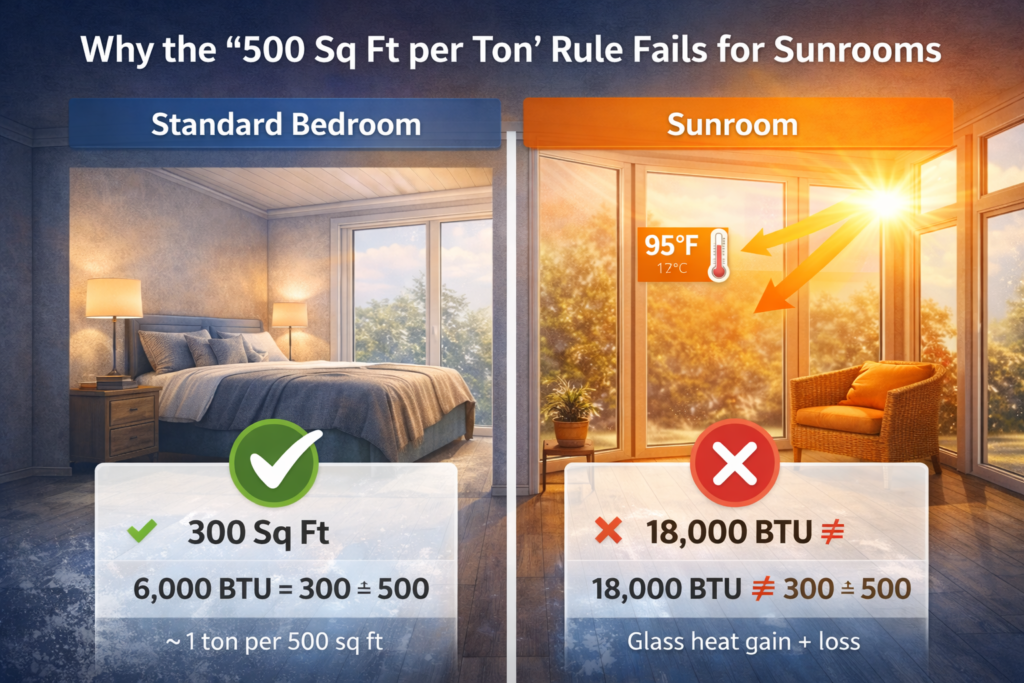
In standard construction, a rule of thumb suggests that 1 ton of air conditioning (12,000 BTU/hr) is sufficient for 500 to 600 square feet of living space.
Scenario:
15’ x 20’ sunroom (300 sq. ft.)
- Standard Rule: 300 ÷ 500 ≈ 0.6 tons (7,200 BTUs)
- Typical Result: Contractor installs a 9,000 BTU unit
In reality, a 300 sq. ft. sunroom with single-pane glass and western exposure in a Zone 5 climate can have a heating load at 0°F exceeding 24,000 BTUs per hour.
2.2 Advanced Load Calculations for High-Glazing Spaces
To accurately size a system for a sunroom, specific multipliers must be applied.
Glass Area Heat Loss Formula:
Q = U × A × ΔT
With:
- ΔT = 70°F (70°F inside / 0°F outside)
- A = 300 sq. ft. of single-pane glass
- U = 1.1
Result:
1.1 × 300 × 70 = 23,100 BTU/hr heat loss
This single calculation exceeds the capacity of many small mini-splits.
Additional load factors:
- Solar Gain: West-facing, high-SHGC glass may require 20% to 50% more cooling capacity.
- Infiltration: Sunrooms often have higher air leakage at door tracks and house junctions.
Table 1: Comparative Load Analysis (300 sq. ft.)
| Parameter | Standard Bedroom | High-Performance Sunroom | Vintage Sunroom |
|---|---|---|---|
| Wall Insulation | R-19 | R-4 | R-1 |
| Ceiling Insulation | R-38 | R-38 | R-2 |
| Air Leakage | Low | Moderate | High |
| Heating Load (0°F) | ~4,500 BTU/hr | ~12,000 BTU/hr | ~28,000 BTU/hr |
| Cooling Load (95°F) | ~3,000 BTU/hr | ~9,000 BTU/hr | ~18,000 BTU/hr |
| Required System | 6k–9k | 12k–15k | 24k–30k |
2.3 Why Variable-Capacity Inverter Technology Is Essential
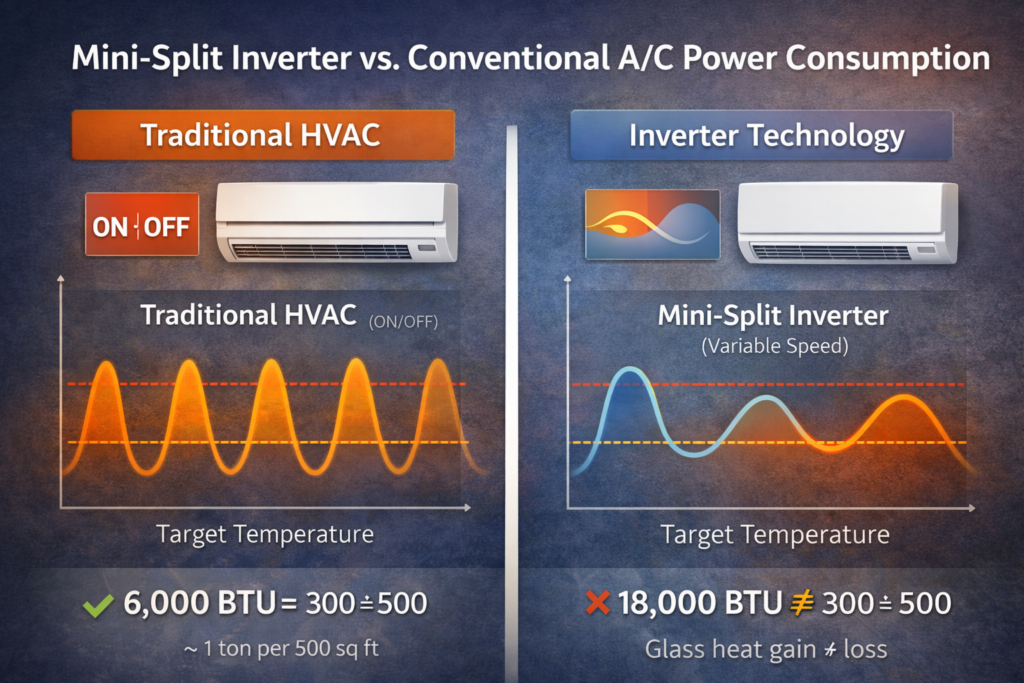
The extreme difference between steady-state load and peak load makes sunrooms the perfect application for inverter-driven systems.
An inverter compressor can modulate output from roughly 15% to 120% of rated capacity.
Key Benefit:
A 24,000 BTU unit can drop to 6,000 BTUs on mild days without short cycling.
Design Strategy:
Oversize for extreme conditions, then rely on inverter modulation for efficiency during normal operation.
3. Why Mini-Splits Win in Sunrooms
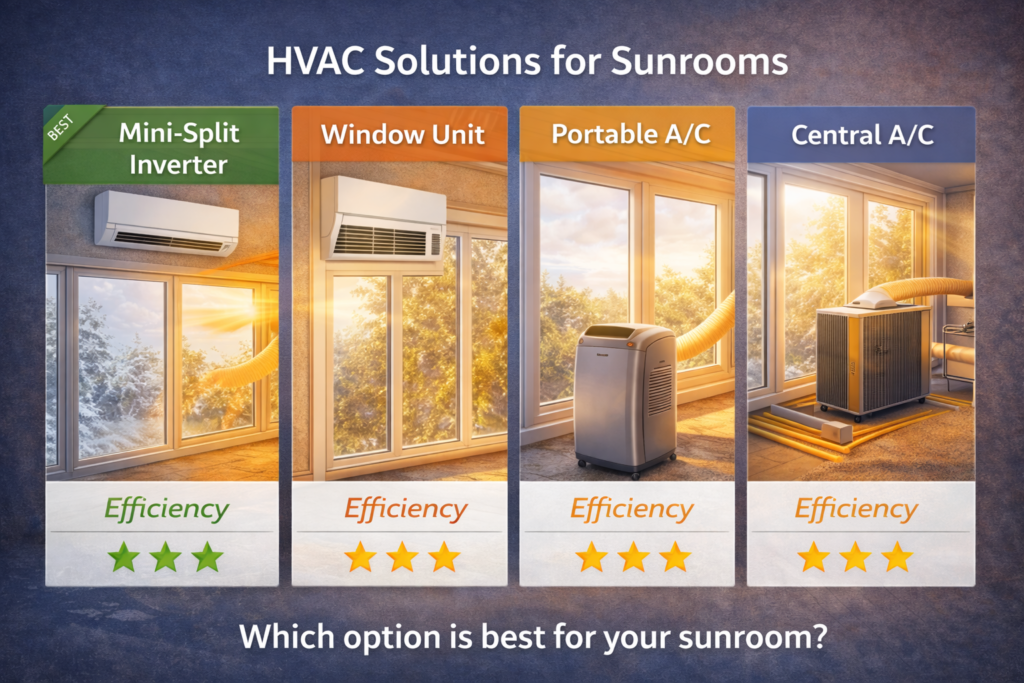
The ductless mini-split heat pump bypasses the limitations of central HVAC systems, especially in glass-heavy additions.
Read Also : Can a Mini Split Really Heat a Whole House in Freezing Weather?
3.1 Inverter-Driven Compressors
Unlike traditional on/off compressors, mini-splits use Variable Frequency Drives (VFDs) to modulate speed continuously.
- Temperature control within ±1°F
- Immediate response to solar gain fluctuations
- SEER2 ratings of 20–30+, far exceeding traditional systems
3.2 Hyper-Heating and Cold Climate Performance
Modern cold-climate heat pumps maintain heating output well below freezing.
Examples:
- Mitsubishi Hyper-Heating (H2i): Full capacity down to 5°F, operation to -13°F
- MrCool DIY Gen 4/5: Heating to -13°F
- Daikin Aurora / Gree Sapphire: Operation to -22°F
For sunrooms in Zones 4–7, low-ambient performance is non-negotiable.
3.3 Refrigerant Transition: R-410A to R-454B
The HVAC industry is transitioning to R-454B refrigerant due to lower global warming potential.
Key implications:
- New units include leak detection sensors
- Safety codes limit oversizing in small enclosed spaces
- R-454B systems represent future-proof equipment choices
4. Equipment Recommendations
4.1 Professional Grade: Mitsubishi Electric
- Models: MSZ-FS (Wall Mount), MFZ-KJ (Floor Mount)
- 3D i-see Sensor for hot/cold spot detection
- Superior sub-zero performance
- Premium cost, professional installation required
Read our full review about Mitsubishi Mini Split
4.2 DIY Option: MrCool
- Pre-charged Quick Connect line sets
- Lower upfront cost
- Heating to -13°F
- Trade-offs in aesthetics, serviceability, and long-term support
Read Also our ultimate review about Senville vs MrCool DIY: Is the Price Difference Worth It?
Table 2: 2026 Mini-Split Comparison (12k BTU)
| Feature | Mitsubishi MSZ-FS | MrCool DIY Gen 4 | Gree Sapphire |
|---|---|---|---|
| Class | Pro Premium | DIY | Pro High-Efficiency |
| SEER2 | 23.1 | 22 | 30.5 |
| Low Ambient Heat | 100% at 5°F | -13°F | -22°F |
| Sound Level | 20 dB | 23.5 dB | 19 dB |
5. Installation Challenges in Sunrooms
Key considerations:
- Limited wall space
- Glass-dominated structures
- Line set concealment
- Electrical and code compliance
Floor consoles and ceiling cassettes often outperform wall-mounted units in sunrooms due to superior airflow distribution.
6. Cost, ROI, and Incentives (2025–2026)
6.1 Cost Comparison
- Professional Install: $6,000 – $9,700
- DIY Install: $2,800 – $3,500
6.2 Federal Tax Credit (IRA 25C)
- 30% credit up to $2,000
- Applies to qualifying high-efficiency heat pumps
Read Also : How to Claim Your $2,000 (Inflation Reduction Act) Mini split Tax
6.3 Mini-Split vs Electric Baseboard
Mini-splits are 300–400% more efficient and typically pay for themselves within 3–5 years.
7. Best Practices for Operation
- Avoid deep temperature setbacks
- Expect defrost cycles in winter
- Use Dry Mode for summer humidity
- Leverage smart controls for solar gain management

8. Conclusion: The Definitive Sunroom Solution
The physics are clear. Traditional HVAC strategies fail in sunrooms due to massive solar gains, rapid conductive losses, and convective stratification.
Mini-splits, with inverter technology and low-ambient heating, are the only systems capable of adapting to these extremes.
Final Takeaways:
- Size for worst-case conditions
- Prioritize low-ambient heating
- Choose the right indoor unit form factor
- Leverage tax incentives
With the right mini-split system, a sunroom transforms from a seasonal novelty into a true four-season living space.