Mini Split BTU Sizing: The Truth About Manual J (2026)
Are you ready to gamble $2,000? Because that is exactly what you are doing when you choose a mini split size based on a guess.
The scenario happens every day: A contractor walks in, looks around, and says, “This room looks big. Let’s throw in a 24,000 BTU unit just to be safe.” Stop right there. 🛑 That advice is the fastest way to ruin your comfort and your wallet.
In this 2026 engineering masterguide, we are going to tear down the old “Rules of Thumb,” explain why Oversizing is actually worse than undersizing, and show you how to calculate the Thermal Load like a pro.
Why the “Rule of Thumb” Fails (The Short-Cycling Trap) 📉
You have heard the famous equation: “Multiply the square footage by 20.” In the 1970s, that worked. But in 2026? It’s a disaster.
Why? Because modern homes are different. Insulation has evolved (Higher R-Value), and windows are now double-paned. If you use an old equation on a modern home, you will buy a unit that is way too big.
The Big Problem: Short Cycling ⚠️
When you install a massive mini split in a standard room, here is what happens:
- The unit cools the room instantly (in 5 minutes).
- The sensor thinks the job is done and shuts off.
- Ten minutes later, the temperature rises, and it blasts on again.
The Result?
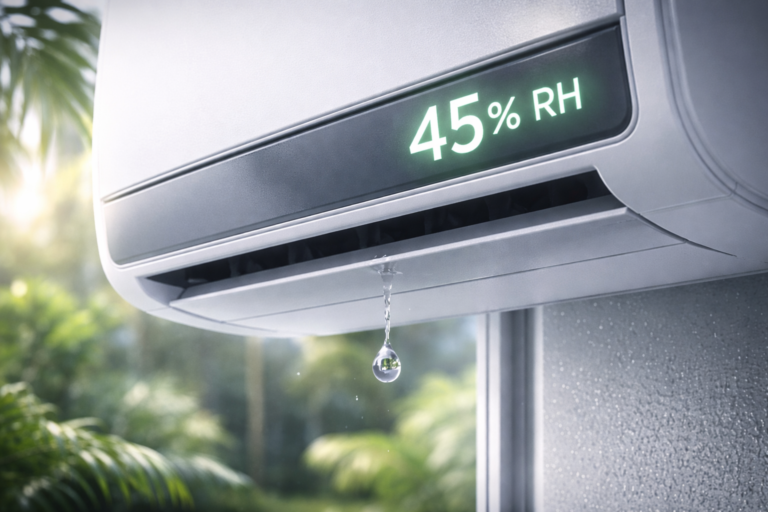
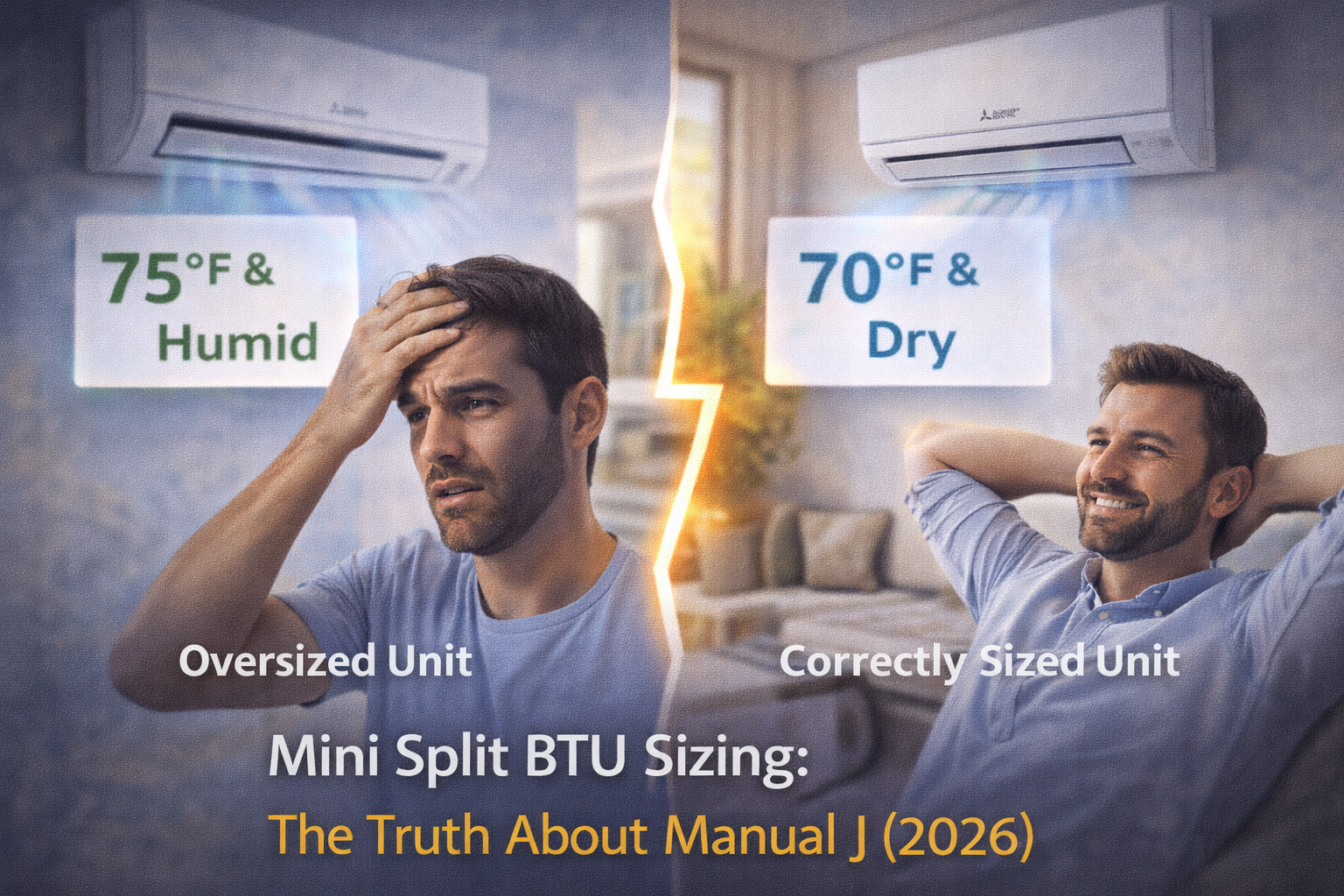
- High Humidity: The unit didn’t run long enough to pull moisture out of the air. The room feels cold but “clammy.”
- High Bills: Starting and stopping the compressor consumes massive energy.
- Early Failure: This constant on/off cycle destroys internal components.
👉 The Fix: The correct size allows the inverter to run continuously at a low, quiet speed, saving money and dehumidifying the air.
The 2026 Square Footage to BTU Chart (Estimates) 📊
We hate estimates, but we know you want a starting point.
This chart is based on average US homes (8ft ceilings, standard insulation).
| Room Size (Sq. Ft.) | Minimum BTU | Maximum BTU | Recommended Size |
| 150 – 250 sq ft | 6,000 | 9,000 | 9k BTU |
| 250 – 350 sq ft | 9,000 | 10,000 | 9k or 12k BTU |
| 350 – 500 sq ft | 10,000 | 14,000 | 12k BTU |
| 500 – 750 sq ft | 14,000 | 18,000 | 18k BTU |
| 750 – 1,000 sq ft | 18,000 | 23,000 | 24k BTU |
| 1,000 – 1,300 sq ft | 23,000 | 30,000 | 30k or 36k BTU |
🛑 WARNING: This chart assumes your room is “perfect.” If you have high ceilings or an uninsulated garage, this chart is wrong.
👉 Don’t Guess: Use Our Precision BTU Calculator Here
Hidden Factors That Change the Math (The Thermal Envelope) 🏗️
This is where the pros beat the amateurs. A real load calculation (Manual J) doesn’t just look at the floor; it looks at the room’s Thermal Envelope.
1. Ceiling Height (Volume vs. Area)
Air conditioners cool volume, not just square footage.
Most charts assume 8ft ceilings.
- Do you have 10ft ceilings? Add 20-25% to the load.
- Do you have vaulted/cathedral ceilings? You need a specific calculation.
2. Insulation Quality (R-Value)
- Old Home (Pre-1980): High air leakage = Needs more power.
- New Home: Tight seal = Needs less power. (Do not oversize!)
3. Sun Exposure & Windows
A room with large windows facing South or West is essentially a solar oven.
- A single large west-facing window can add 3,000 BTUs of heat load alone!
Special Use Cases: Garages & Mobile Homes 🏚️🚗
Not all rooms are created equal. Some spaces “eat” energy.
The Garage Factor
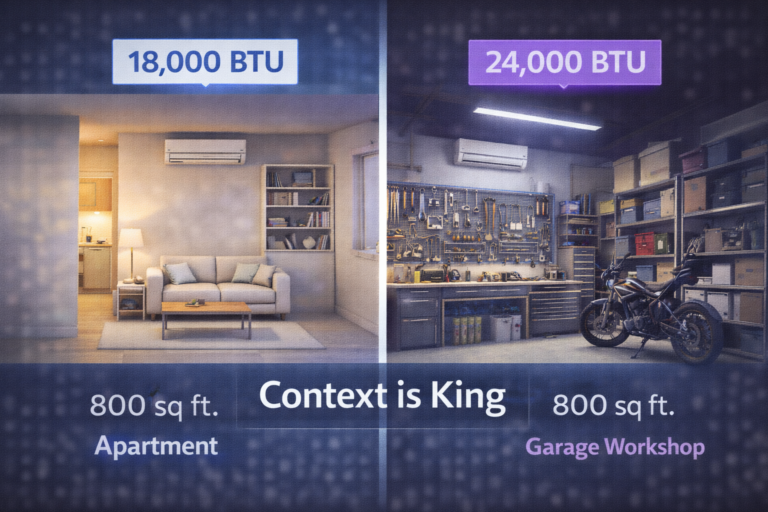
A garage is not a bedroom. The concrete slab absorbs and stores heat. The walls are often thin. The door leaks air.
- The Rule: You must upsize by 30% to 50% compared to a standard room.
- Example: If a 400 sq ft bedroom needs 12k BTU, a 400 sq ft garage needs 18k BTU.
👉 Read the Full Guide: Garage Mini Split Sizing & Insulation
The Mobile Home Challenge
Walls are thinner, and thermal transfer is rapid. Heat penetrates the home quickly.
- Sizing must be aggressive to handle extreme summer peaks.
👉 Read: Mobile Home Mini Split Sizing Guide
Manual J vs. AI-Assisted Calculators 🧠
Engineers use a protocol called Manual J to calculate everything (from glass type to roof color).
- Pros: 100% Accurate.
- Cons: Extremely complex, and contractors charge $300-$500 to do it.
Is there a middle ground?
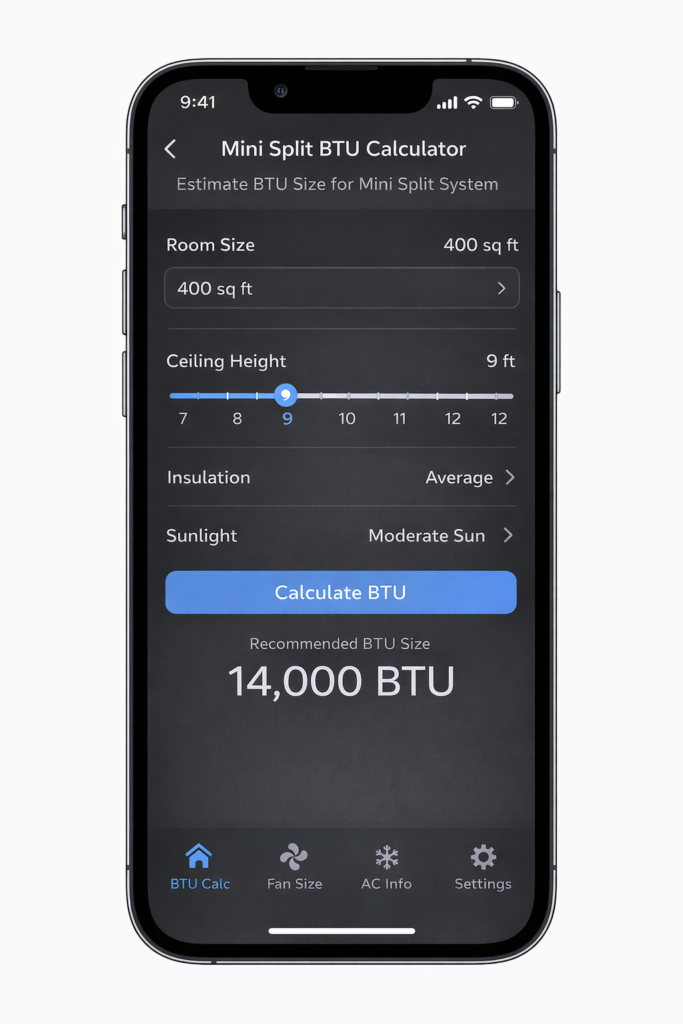
Yes. We have programmed the logic of Manual J into our free tool.
Instead of paying an engineer or guessing with a chart, you input your specific details (Ceiling, Insulation, Sun), and our algorithm gives you the engineered number.
Don’t Burn Your Money 🔥
Sizing isn’t just a number. It is the difference between a comfortable home and a nightmare electricity bill.
- Ignore the old “Rule of Thumb.”
- Assess your “Thermal Envelope” (Insulation, Windows).
- Watch out for special cases (Garages, Basements).
- Most importantly: Calculate, don’t guess.
👉 Your Next Step: Want the exact number right now? Click Here to Use Our Smart Mini Split Calculator (Free)