

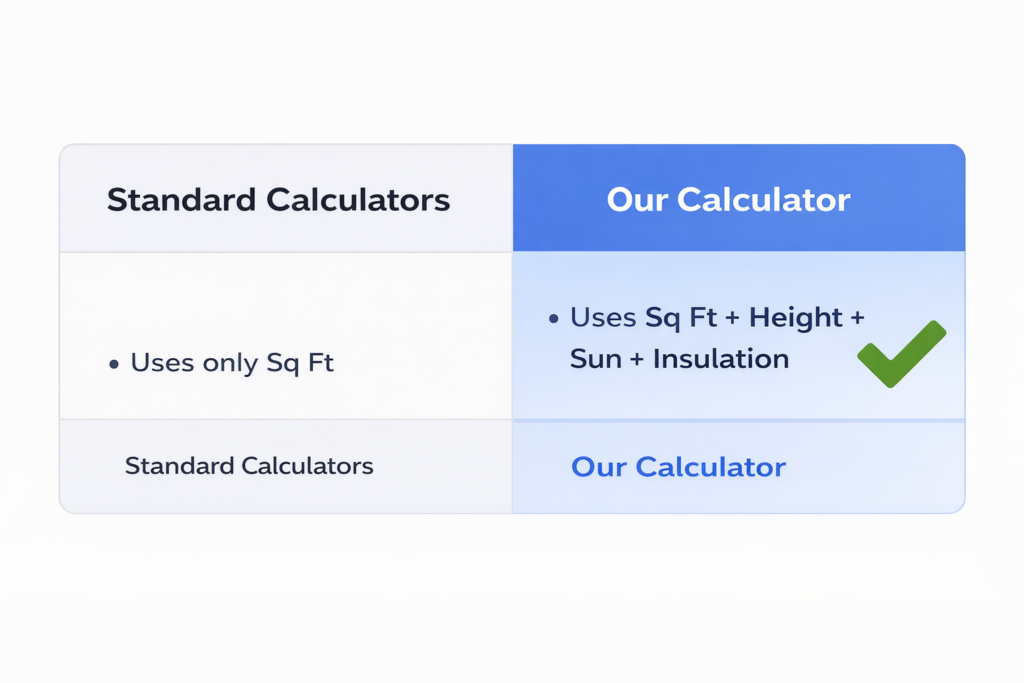
When you search Google for a “Mini Split Calculator,” you will find dozens of websites. They all ask you for one thing only: Square Footage.
Then they give you a number: “You need 12,000 BTU.” Did you know that number could be wrong by up to 50%?
At MiniSplitSizer.com, we didn’t just build a basic calculator. We programmed a digital HVAC engineer. Our algorithm is built on the principles of Manual J (the gold standard for HVAC sizing), not on “Rules of Thumb.”
Here is how our tool “thinks” when you hit calculate, and why it is the most accurate tool on the market.
1. We Calculate “Volume,” Not Just “Area” 🧊
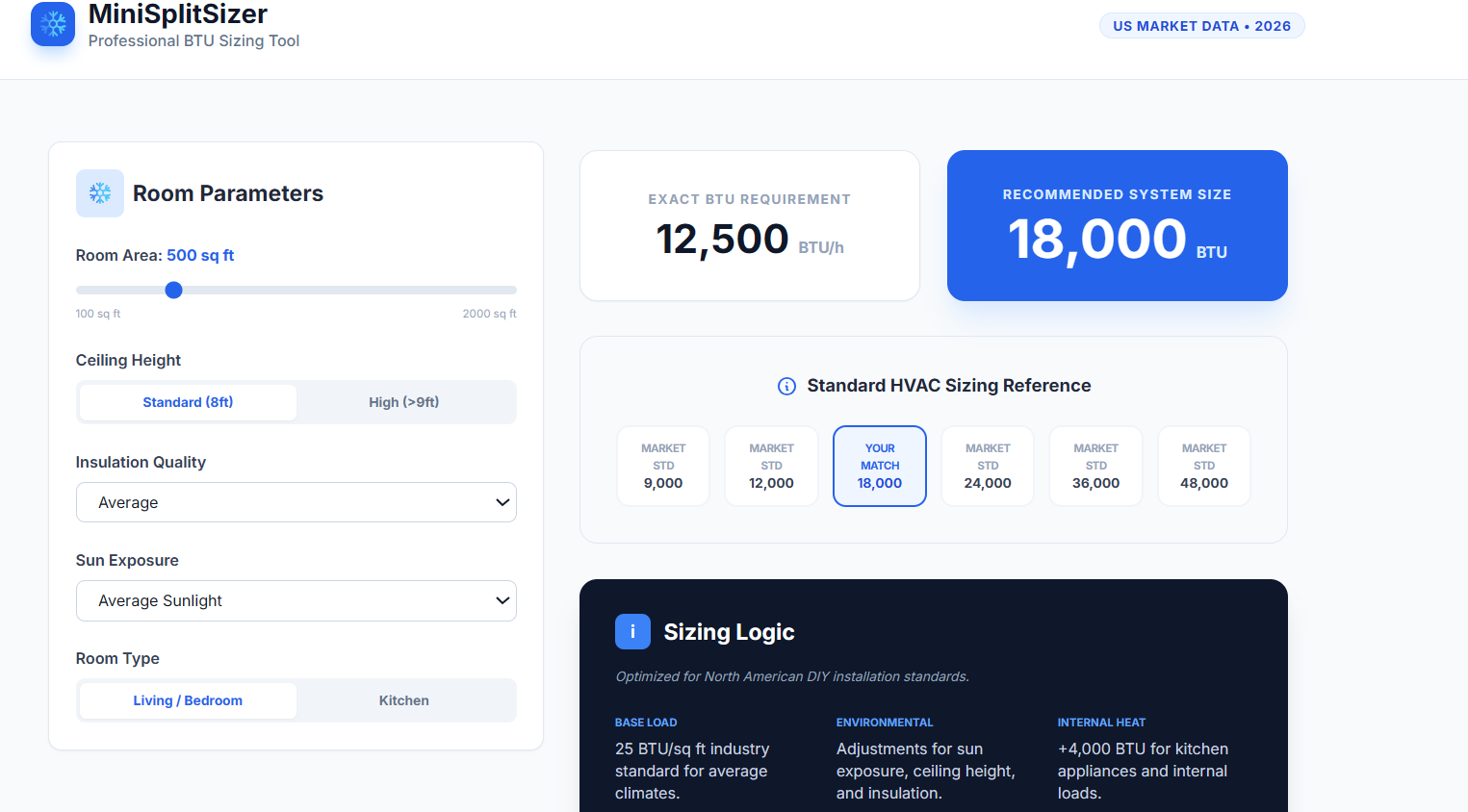
Most online calculators assume your ceiling is a standard 8 feet high. But what if you have a 12-foot vaulted ceiling?
- Other Calculators: They will still tell you 12,000 BTU (because the floor area didn’t change).
- The Result: Your room will be hot because there is 50% more air volume that wasn’t accounted for!
- Our Tool: We ask for “Ceiling Height.” Our code adds a specific correction factor for every extra foot of height, ensuring the entire room is cooled from floor to ceiling.
2. The “Solar Oven” Factor (Sun Exposure) ☀️
Does your room face North (cool) or West (baking hot at sunset)? A west-facing window acts like a natural heater in the summer.
- Other Calculators: They ignore sunlight completely.
- Our Tool: When you select “Heavily Shaded” or “Direct Sunlight,” our algorithm adjusts the thermal load by approximately 30%. This prevents you from buying a unit that collapses under the heat of the afternoon sun.
3. Insulation Quality (The R-Value Factor) 🏠
Was your home built in 1950 (drafty) or 2024 (tightly sealed)? Cold air is like water in a bucket; if your bucket has holes (bad insulation), you need to pump more water to keep it full.
- The Secret Code: We have programmed leakage factors into the tool. If you select “Poor Insulation,” the tool increases the required power to compensate for thermal loss.
4. Kitchens & Garages (Heat Generators) 🍳🚗
Are you cooling a quiet bedroom, or a kitchen boiling with an oven and fridge? Are you cooling a garage with a concrete slab that absorbs heat?
- Appliances and humans generate “Sensible Heat.”
- Our Tool: We add 400-600 BTUs for each additional person and include safety margins for kitchens and garages to ensure the compressor doesn’t overheat.
Why Accuracy Matters (The Danger of Oversizing) ⚠️
You might say: “I’ll just buy the biggest unit and not worry about the details.” That is a huge mistake.
- If you buy too small: It will never cool the room (the compressor runs 24/7 and burns out).
- If you buy too big (Oversized): You will hit the Short Cycling trap.
- The unit cools too fast and shuts off.
- It doesn’t run long enough to remove humidity.
- Result: A cold but “clammy” and sticky room, plus a higher electric bill.
Our tool gives you the “Goldilocks Number”: Not too big, not too small. Just right.
How to Use the Tool (3 Steps) 🛠️
- Measure the Room: We just need Length and Width.
- Be Honest:
- High ceilings?
- Does the sun hit the room all day?
- Is the wall insulation good?
- Get the Result: The tool gives you the exact BTU requirement, and we recommend the nearest commercial size (e.g., if the result is 10,500, we recommend 12k).
Conclusion
We didn’t write this code for fun. We wrote it because we were tired of seeing homeowners waste money on the wrong units due to “Rule of Thumb” advice.
Science is at your service. And numbers don’t lie.